Category

Uncategorized

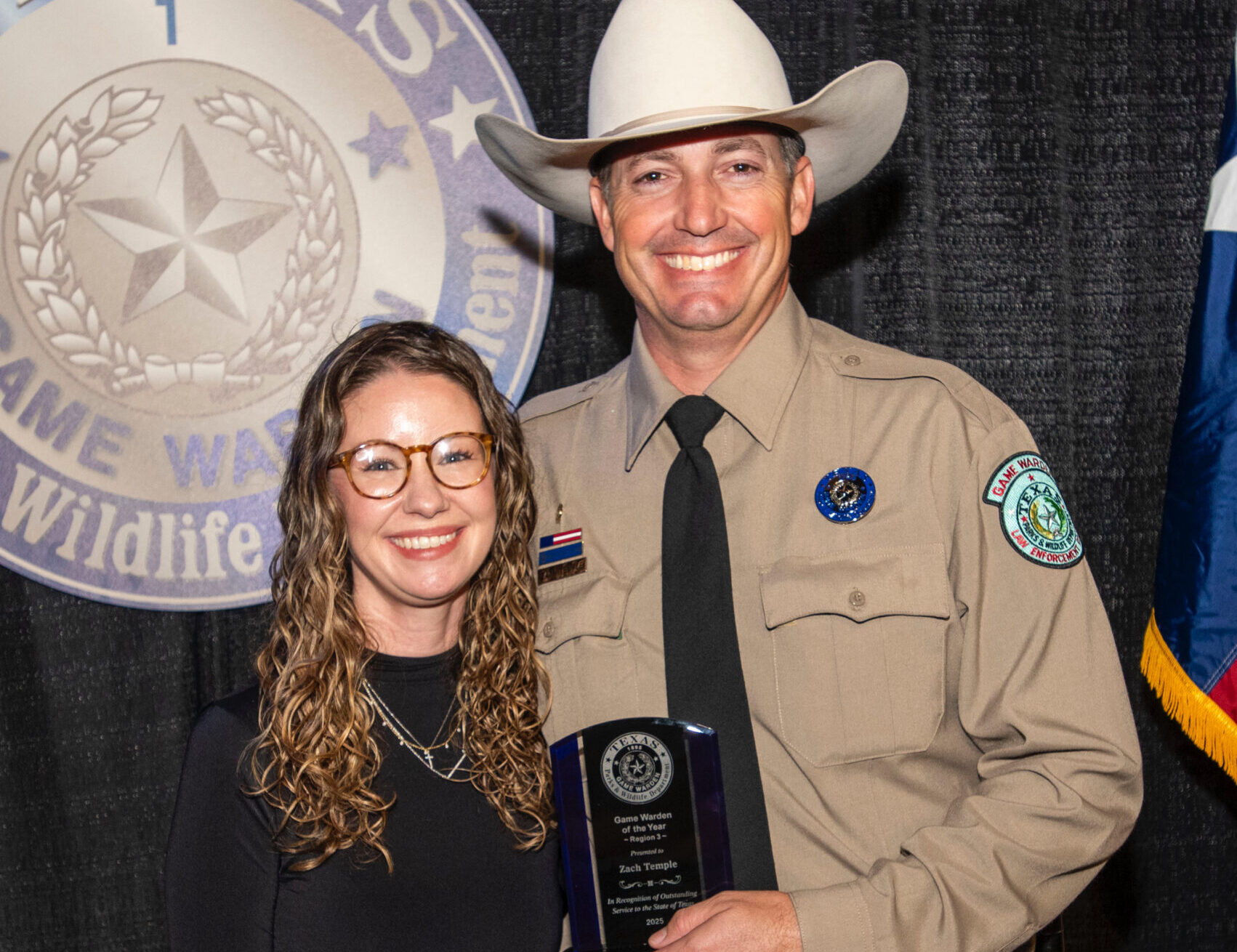
Meet Texas Game Warden Zach Temple

By | Uncategorized

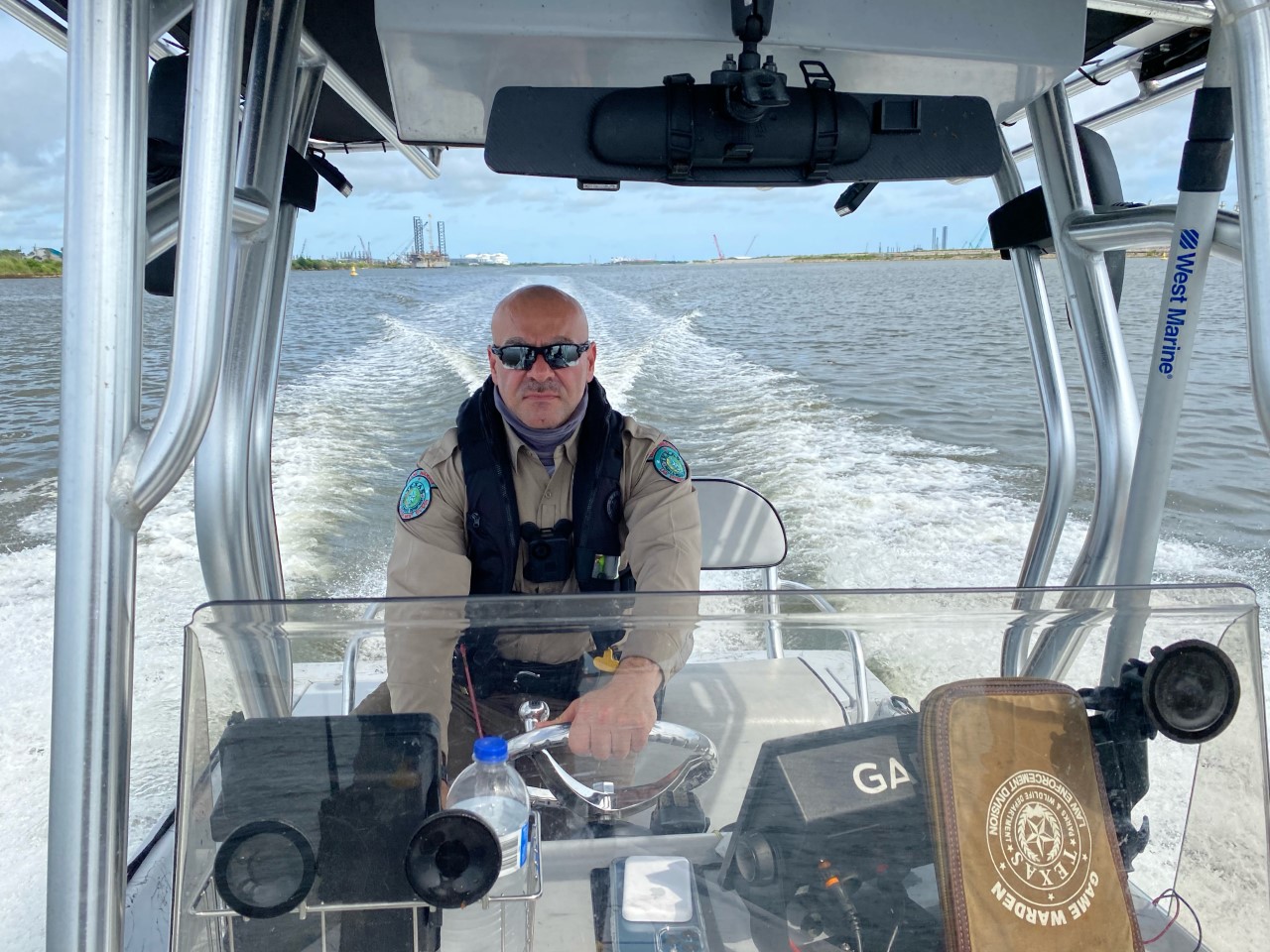
When natural disaster strikes, Texas Game Warden Zach Temple doesn’t wait to be called. For more than a decade, he’s volunteered to be among the first to respond. As a member of the elite Search and Rescue Team, Temple is on the front lines of some of the most harrowing work Texas Game Wardens perform.
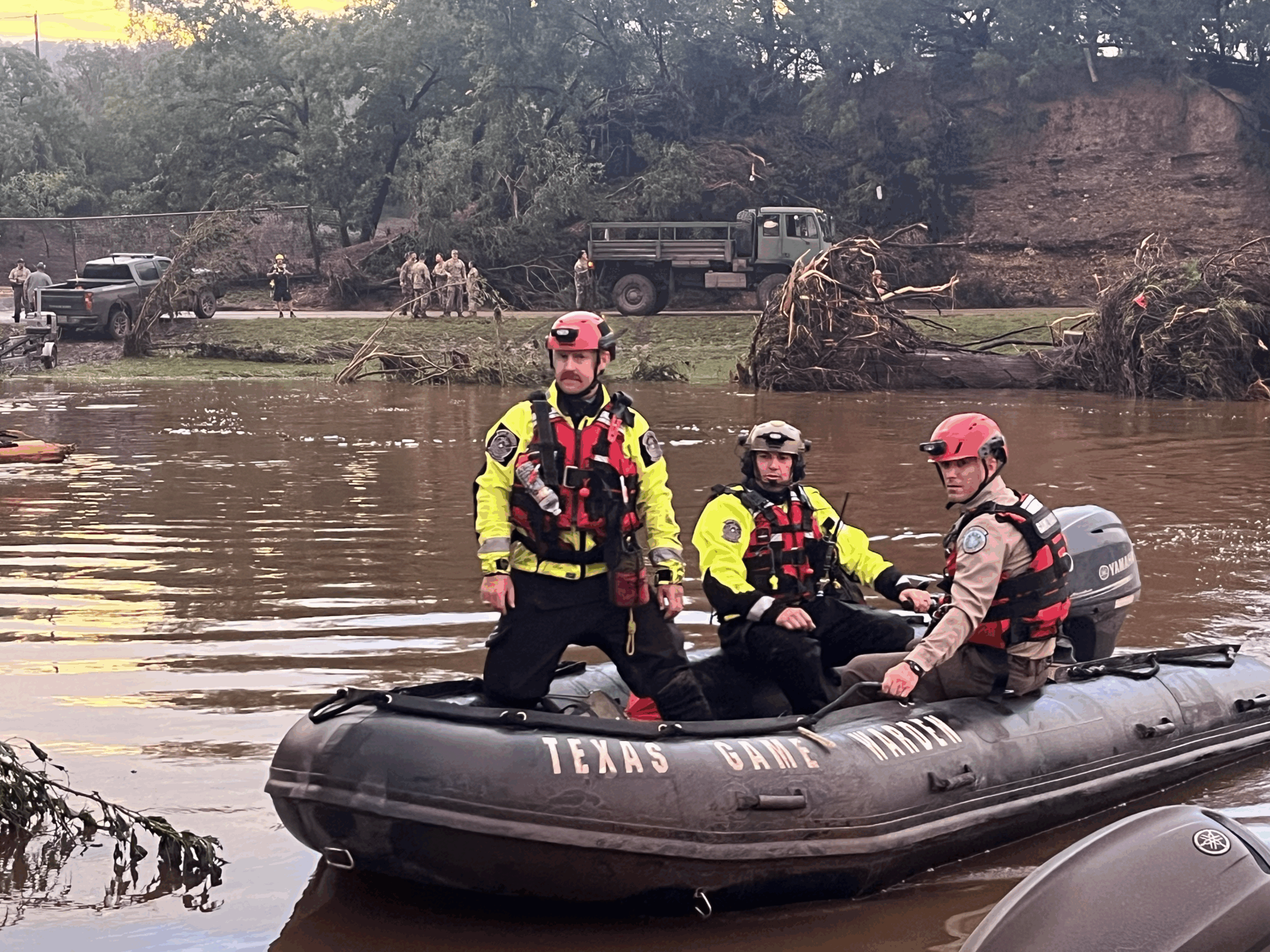
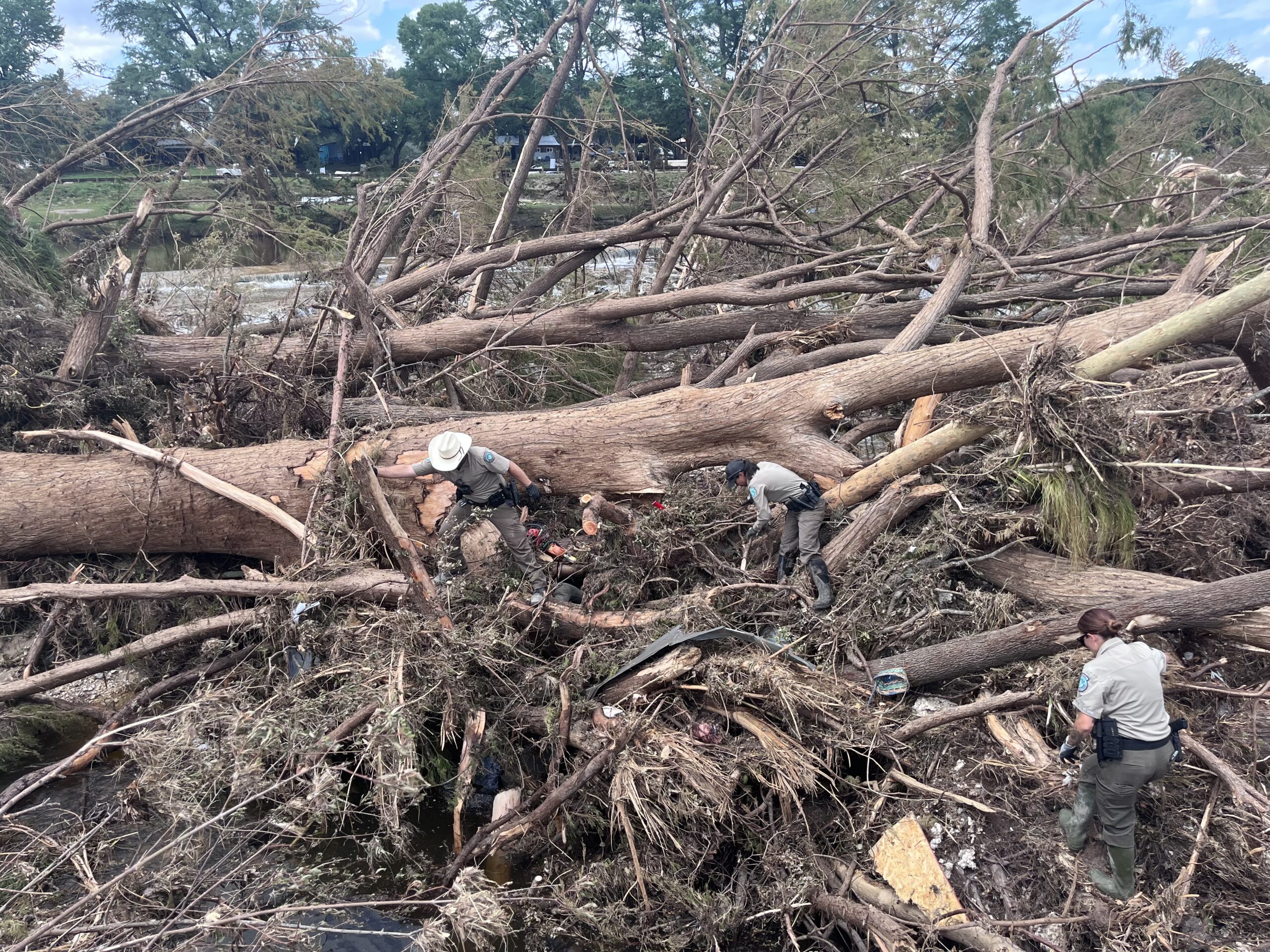
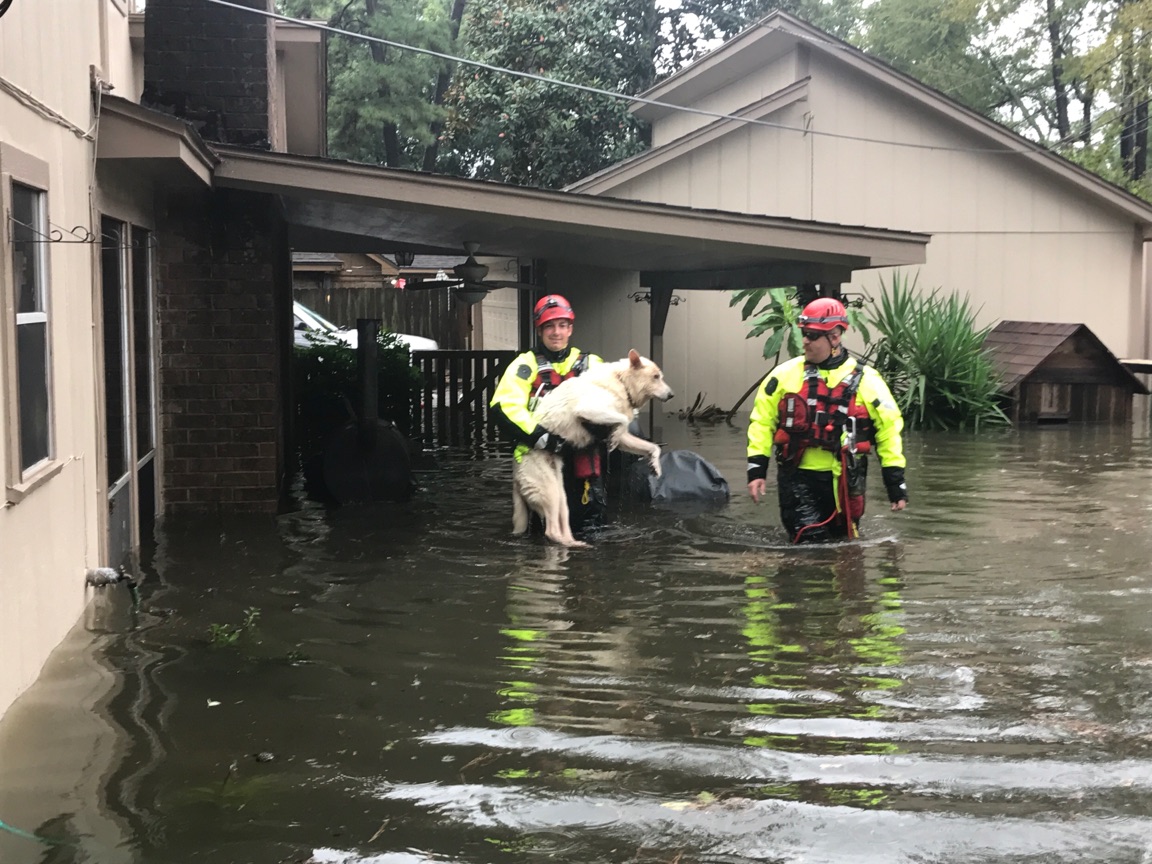
It’s a volunteer assignment that comes with no additional compensation. The work is physically demanding, emotionally taxing, and often dangerous. His first major deployment came less than a year after he joined the team, and he spent nearly two weeks helping evacuate flooded communities across Southeast Texas in the aftermath of Hurricane Harvey. Last year, he was among the first crew to reach Camp Mystic, helping evacuate children before joining fellow game wardens in the heartbreaking search for survivors along the Guadalupe River.
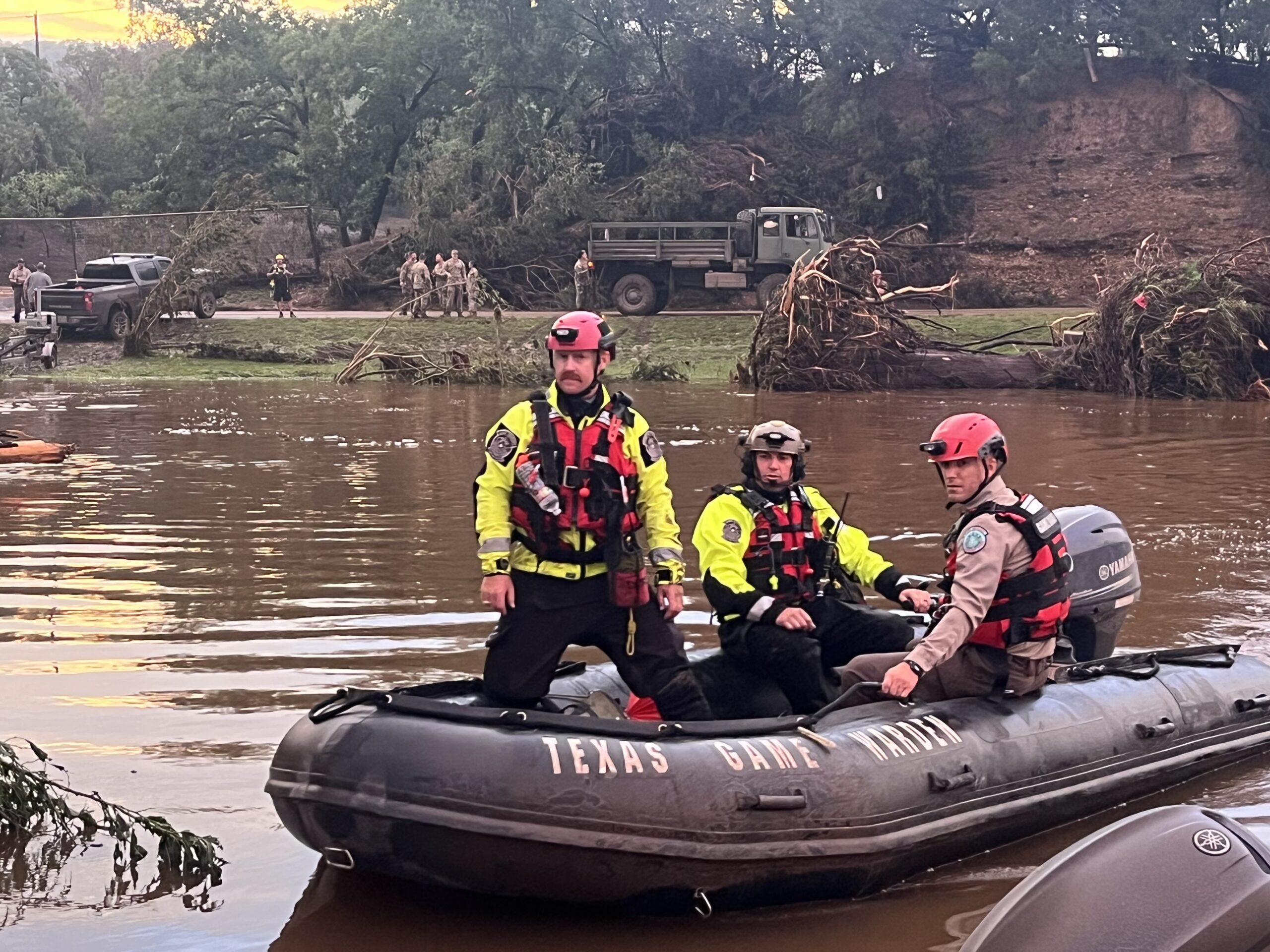
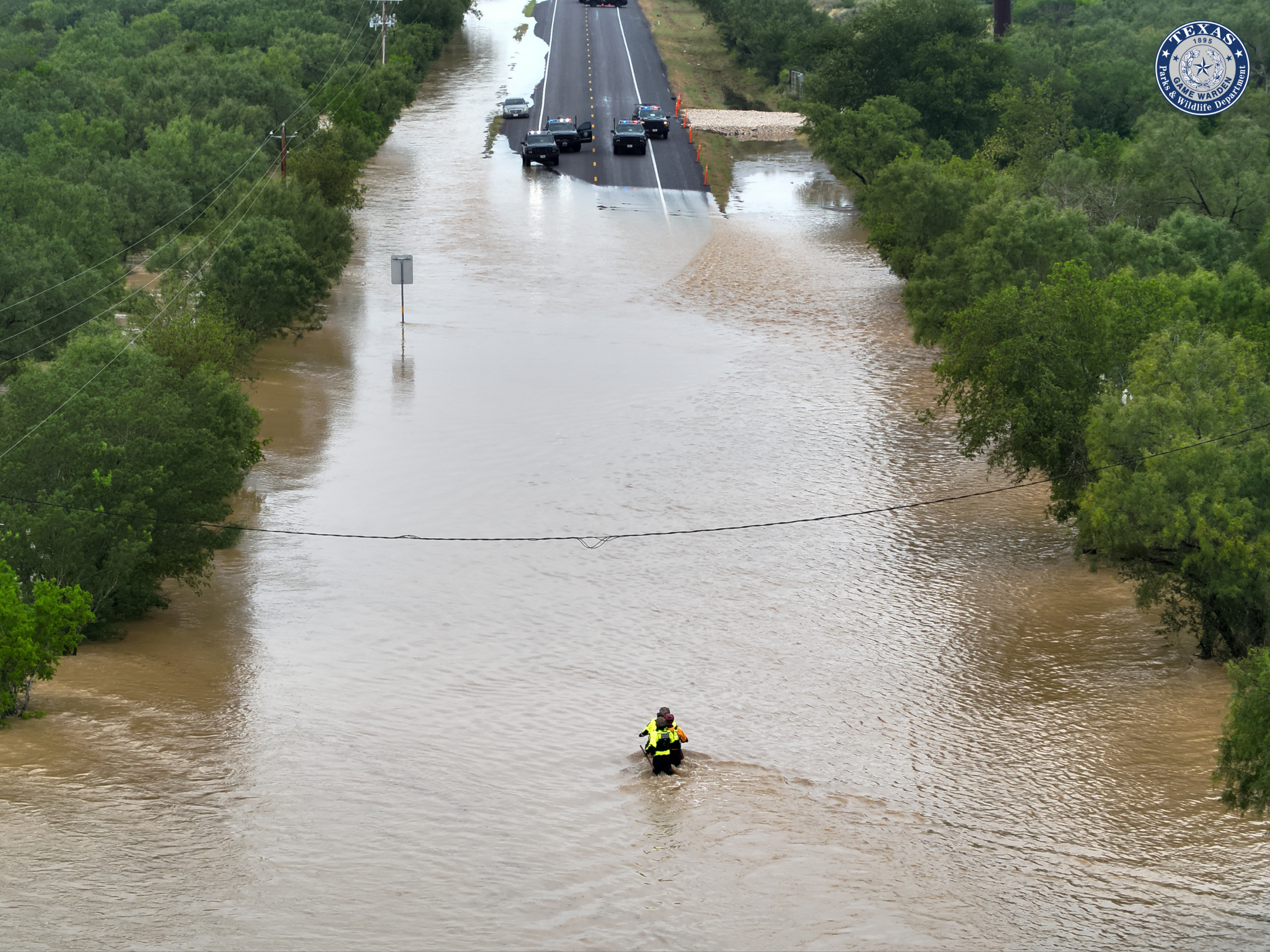
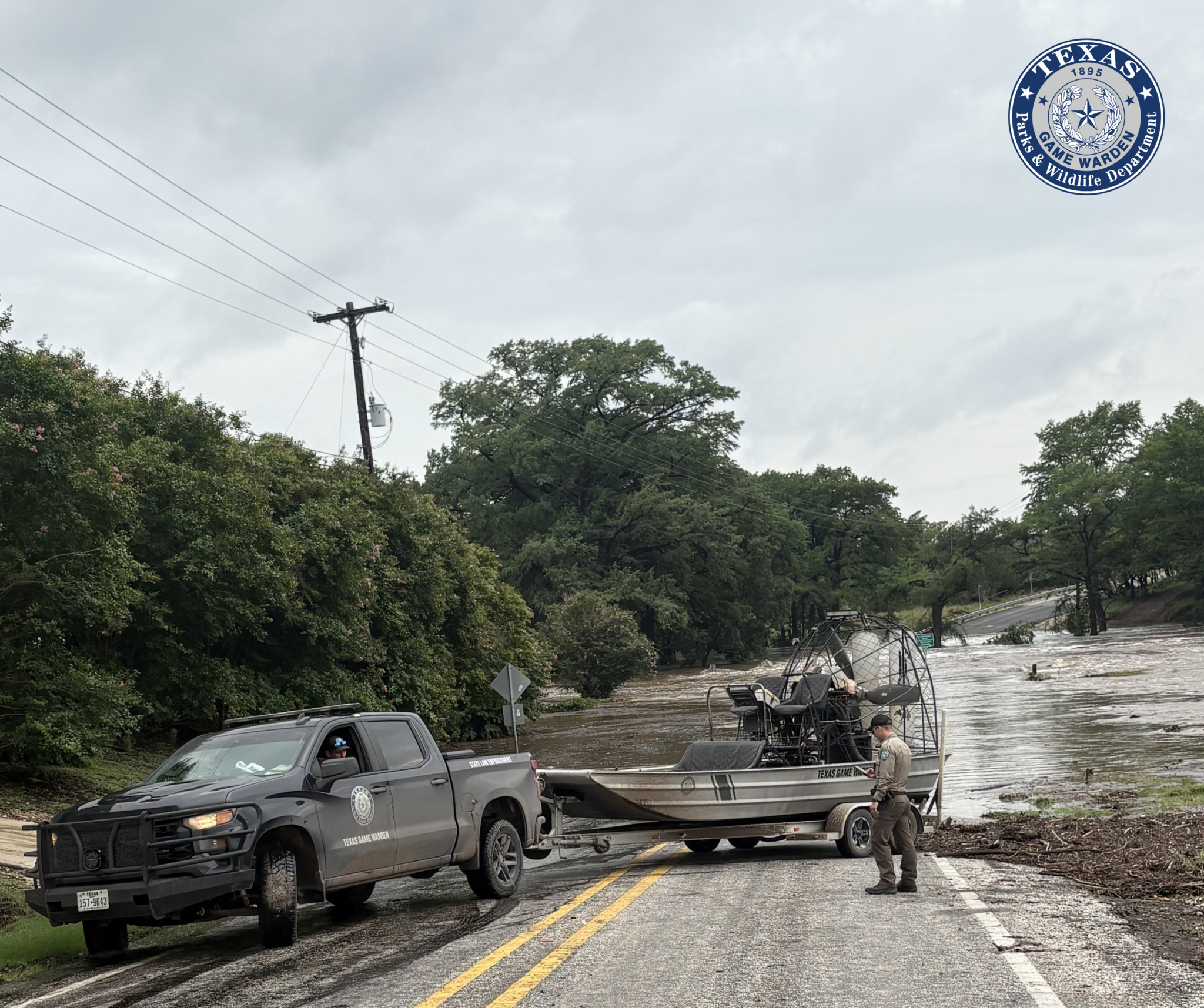
In July 2026, as heavy storms were forecast for the Texas Hill Country and South Central Texas, Temple was staged in Del Rio before deploying across flood-stricken communities in Uvalde, Brackettville, Camp Wood, and Leakey. As rising water cut off roads and submerged low-water crossings, he worked alongside fellow Texas Game Wardens and other first responders to carry out search and rescue operations for stranded residents.

“I think every Texas Game Warden wants to help,” said Temple. It’s a good feeling to be able to help somebody.”
For Temple, helping others has been the driving force behind his career. He grew up hunting and fishing in East Texas, and by middle school, he knew he wanted to be a game warden.

“I just had a passion for conservation, and I wanted to make a difference in my community,” he said. He earned a degree at Stephen F. Austin State University in criminal justice with a minor in forestry wildlife management. While in college, he did ride-alongs with local game wardens, which reinforced his path.

When he graduated from the Texas Game Warden Academy in 2013, his first assignment took him to Presidio County in West Texas. That complicated his personal life, as he and his wife Kayleigh spent the first year of their marriage living apart while she completed her residency in San Antonio. In 2016, he transferred back home to Smith County in East Texas, and everything fell into place.

“I think somebody above sees the bigger picture, and it all works out for a reason,” said Temple.  “We were a little stressed being so far apart, but it worked out great. We are very blessed.”
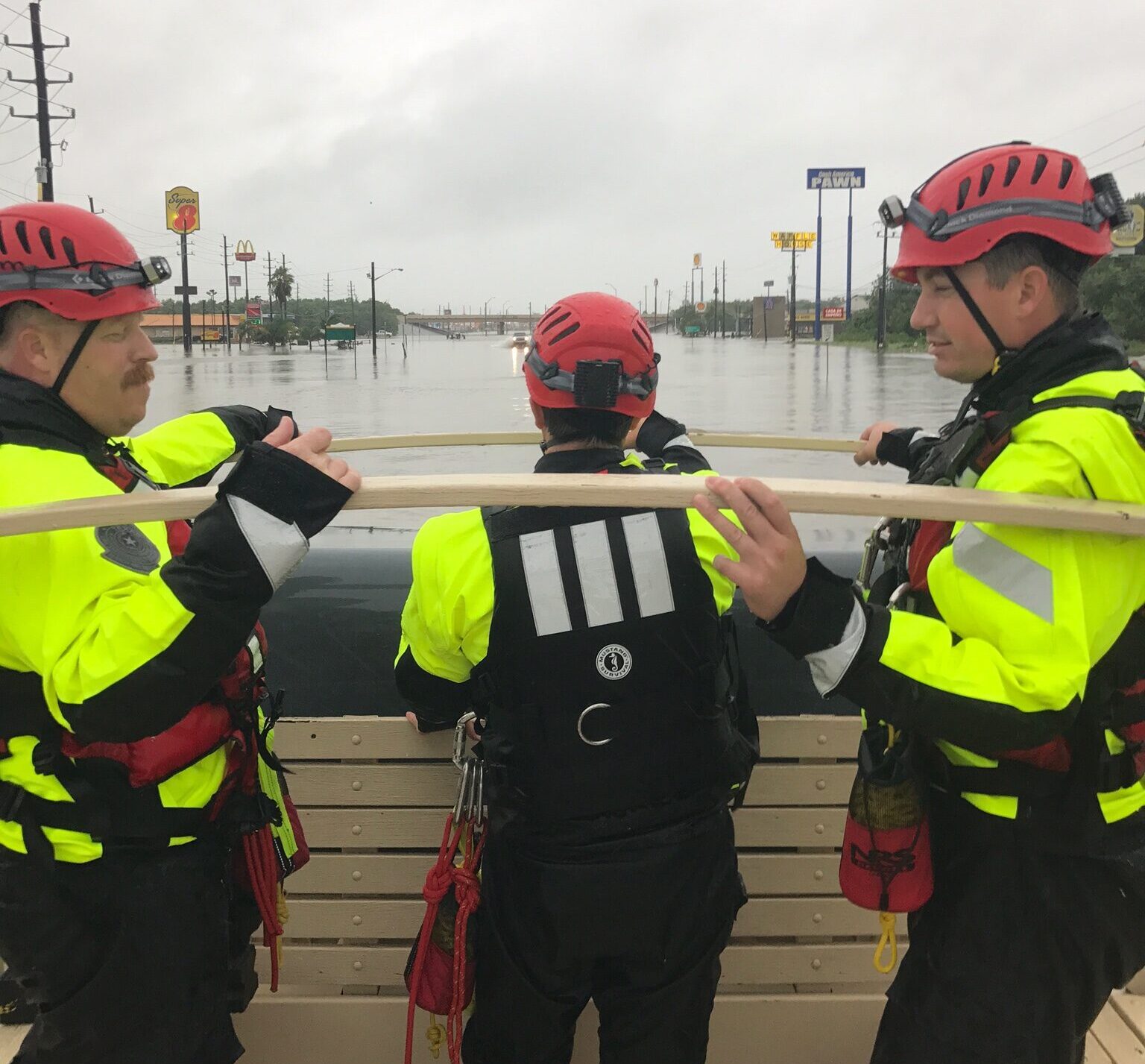
It was in 2016 that Temple raised his hand to join the Search and Rescue Team. “I grew up on the river operating a tiller-handle flat-bottom boat and knew I was a pretty decent operator,” he said. “I knew I had the confidence to help out and make a difference.”

In 2017, TPWF’s S. Reed Morian Gear Up for Game Wardens program was launched, and Temple has experienced firsthand how the program is putting specialized equipment into the hands of Texas Game Wardens who need it.

“We’ve worked hand-in-hand with Gear Up to best equip the team,” said Temple. “We’re recognized nationally for the quality of the equipment we have access to, from the dry suits that protect us from the floodwaters that contain sewage, fuel, and other contaminants, to the headsets that allow us to communicate with each other in some pretty bad situations.”
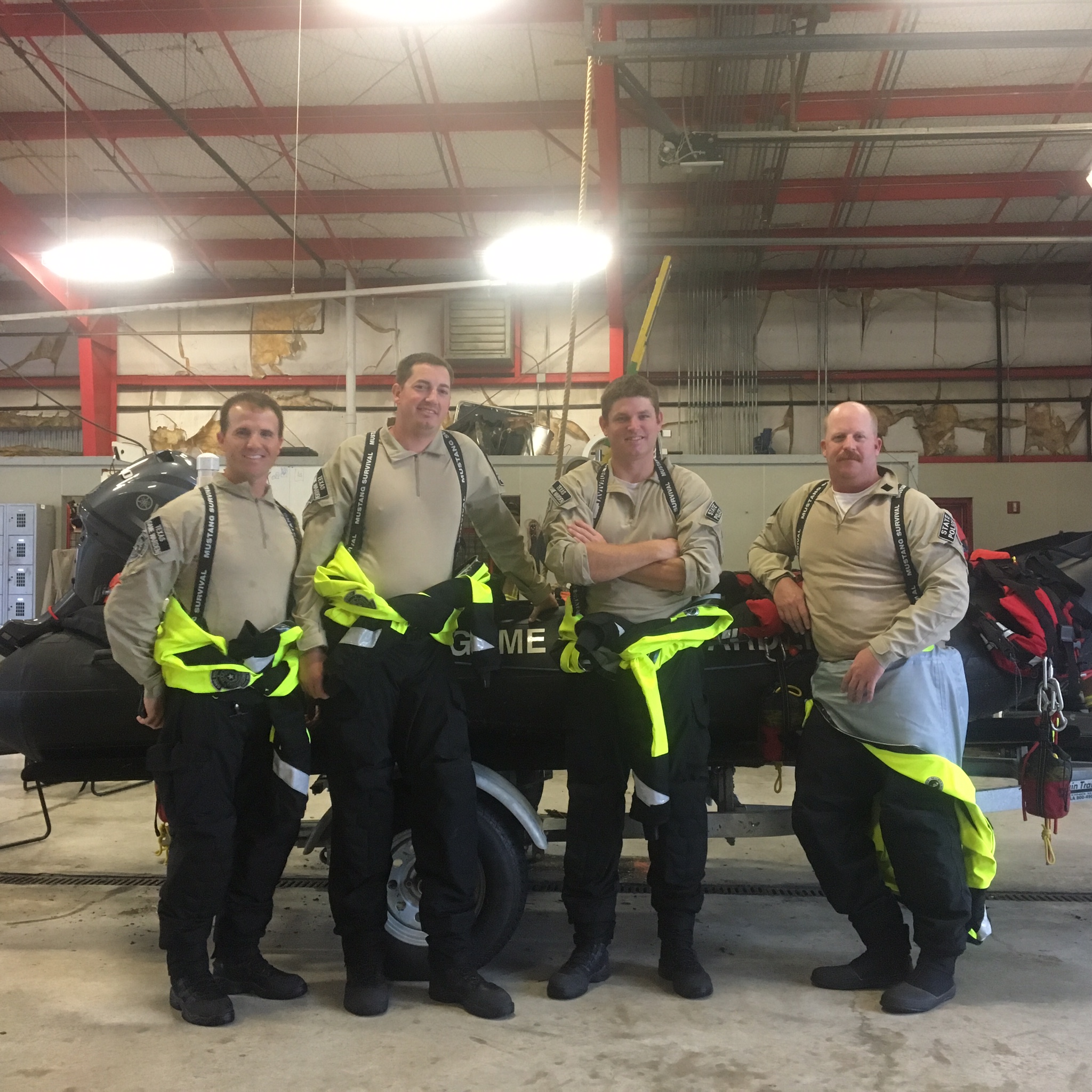
Temple doesn’t just benefit from Gear Up. He’s helping build it. He helped organize the first Gear Up fundraising event in East Texas, which raised more than $90,000. He was blown away by the response. “I’m just so proud of East Texas. People here really care about game wardens,” he said.

Now he’s working on another event for East Texas, which will be held in October 2026. “The donors see the big picture, and we really appreciate how much they care about us. They realize you’re only as good as the tools you have. We train like it’s not if it’s going to happen again, but when.”

“I want to be the best trained that I can be, and I want the best tools in my possession so I know I’m going to succeed—not only to protect myself and my fellow game wardens, but to save a fellow Texan in need.”
Texas Game Wardens Come to the Rescue During July Flooding

By | Uncategorized

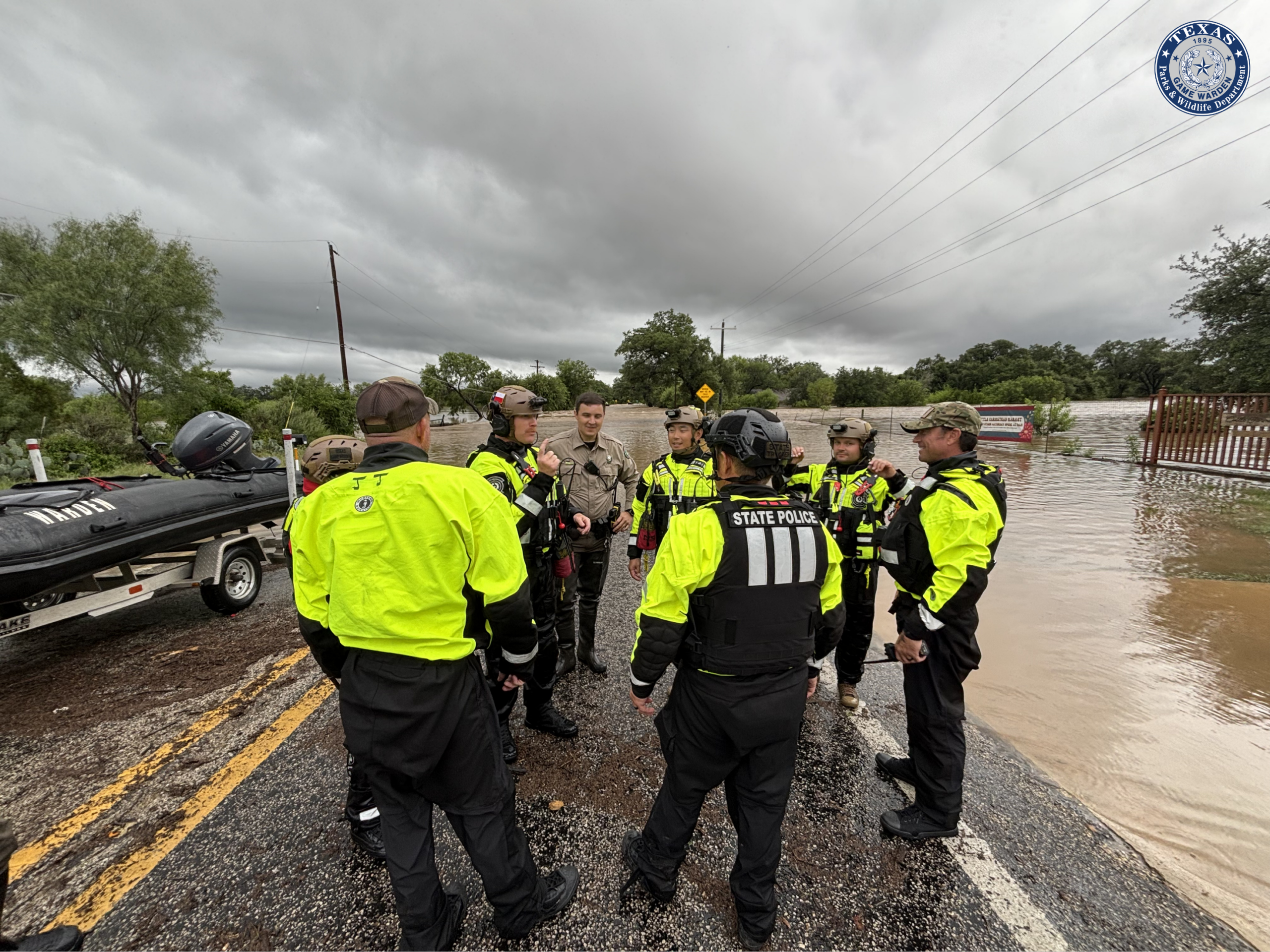
When storm clouds gathered in the Texas Hill Country and South Central Texas in July, Texas Game Wardens were at the ready along with other state and local first responders.

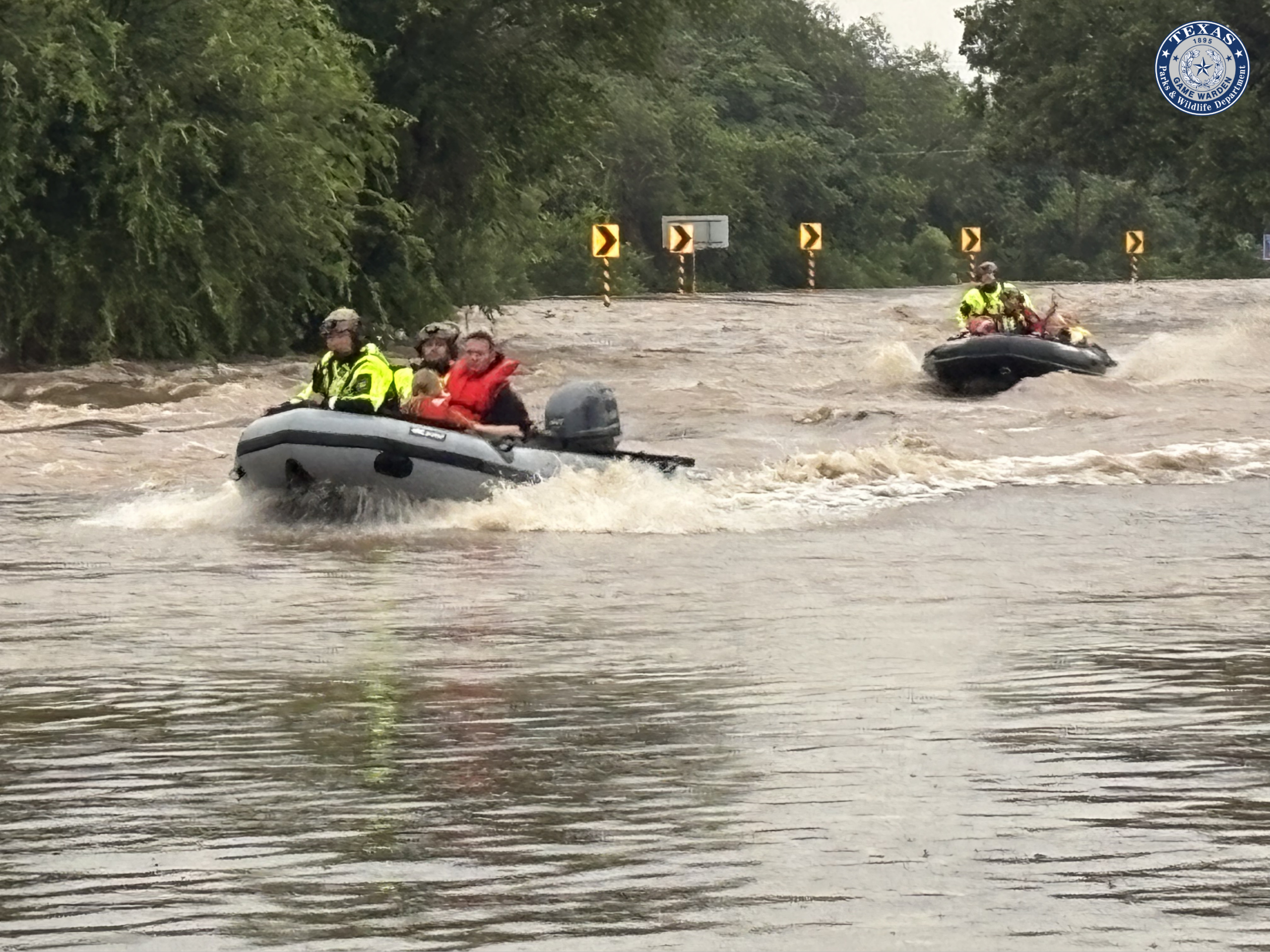
As flooding intensified, 28 members of the Texas Game Warden Search and Rescue Team responded and assisted with 157 rescues and 92 evacuations.

The dramatic rescues captured on the news didn’t happen by chance. They were the result of years of planning, specialized training, and strategic investments that have steadily transformed Texas Game Wardens’ search and rescue capabilities.

Major Brent Satsky has watched the evolution firsthand since he first became a member of the Search and Rescue Team more than ten years ago. He responded to the horrific Wimberley floods in 2015 with the limited equipment they had at the time.

“I remember launching the best rescue boat we had available at the time, with no communications equipment, just our life vests and our training,” he recalled. “The noise in a situation like that is hard to convey. We were literally yelling at each other at the top of our lungs, in torrential rain and flooding, calling out obstacles and doing our best in an incredibly chaotic situation.”

Satsky is now the Major over the entire Special Operations Unit, which includes the Search and Rescue Team and other specialty teams. His years with the Search and Rescue Team coincide with the 2017 launch and subsequent growth of Texas Parks and Wildlife Foundation’s (TPWF) S. Reed Morian Gear Up for Game Wardens program. Through generous donations, Gear Up for Game Wardens provides specialty equipment Texas Game Wardens need to maintain safety and ensure the highest level of service for the people of Texas.

Through Gear Up, the Search and Rescue Team has acquired lifesaving specialty equipment including dry suits, communications headsets, drone technology, specialized rescue equipment, and rescue boats built for swiftwater conditions.

“The last ten years have seen an ongoing evolution of training and especially of the equipment,” said Satsky.  “Gear Up for Game Wardens has played an important role in that transformation. The beautiful part about Gear Up is you can identify a piece of equipment that you need, and through the generosity of Texans who donate to this program, you can just go get it.”

For Satsky, the equipment is only part of the equation. The game wardens who volunteer for the team bring the skill, judgment, and determination required to use it when conditions are at their worst.

“It’s their skills and mindset that make them good at what they do, and their willingness to put themselves in harm’s way,” said Satsky. “But they need to have this specialized equipment in order to do an incredibly difficult job safely. It makes them more effective, more efficient, and ultimately more successful in saving Texans’ lives.”

That progress was evident during the July floods, when they deployed equipment designed for the conditions they faced, from communications headsets that cut through the roar of rushing water to dry suits and rescue boats built for changing conditions.

And, thanks in part to Gear Up, when an inevitable natural disaster strikes again, Texas Game Wardens will be ready and better equipped to answer the call.

From Pup to Partner: The Rigorous Road to Service for K-9s

By | Uncategorized

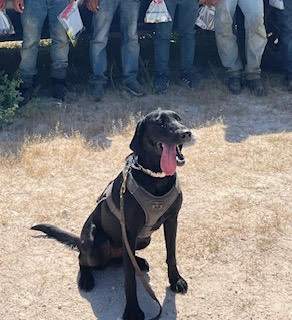
Before a Texas Game Warden K-9 ever answers its first call, months of rigorous training are already behind it. That preparation is underway now with Indy, a young black Labrador Retriever recently recruited for the Texas Game Warden K-9 Team.

Indy’s path to service began well before she ever arrived in Texas from her home state of Connecticut. With an impressive pedigree as the pick of the litter from of a long line of accomplished field trial dogs, she was chosen for her natural drive, athleticism, and confidence — essential traits for dogs expected to work in unpredictable environments.

Within days of her arrival, Indy was introduced to a flurry of unfamiliar sights and sounds, including elevators, busy spaces, and the unfamiliar territory of daily patrol environments. These early experiences help determine whether a dog can later perform in unpredictable settings like debris fields, disaster zones, and rugged, remote terrain.

Indy’s training will progress through a series of structured stages, beginning with foundational obedience, and she will then move into essential skills such as scent tracking, article searches, and basic search-and-rescue behaviors. These skills are practiced in controlled settings before being reinforced in more challenging scenarios.

Once paired with a handler, a K-9 unit typically completes eight weeks of full-time instruction, followed by ongoing work toward certification. Even after deployment, handlers log regular training hours to ensure their K-9 partners maintain peak ability across disciplines.

Training is adapted based on real-world experience. Following last summer’s Hill Country floods, Texas Game Wardens incorporated lessons learned from that disaster response into K-9 training scenarios to better mirror the complex reality of difficult, diminished conditions such as navigating around water barriers and through large debris fields.

Support from the Texas Parks and Wildlife Foundation’s (TPWF) S. Reed Morian Gear Up for Game Wardens program has been central to establishing, expanding, and sustaining the K-9 Team. Funding through Gear Up helps with everything from acquiring dogs like Indy to providing specialized gear or covering travel and training costs.

“What matters most is how a dog responds to new settings,” said Texas Game Warden Royce Ilse, a longtime K-9 handler who oversees K-9 procurement and early training. “A dog can want to work, but if they’re uneasy around noise, crowds, or uneven ground, it limits what they can do in the field.”

“The K-9 program wouldn’t be where it is today without Gear Up,” Ilse said. “It’s what allows us to train these dogs the way we need to so they can serve Texans effectively.”

For now, Indy’s world is full of new experiences and repeated practice. But every exercise builds toward future moments when she may be called to locate someone who is lost or help responders bring answers to a worried family. Thanks to the careful preparation now underway, she’ll be ready to hit the ground running.

To learn more about how last year’s flood response has shaped and strengthened ongoing K-9 training, check out this recent report from KSAT TV in San Antonio.

Eyes in the Sky

By | Uncategorized

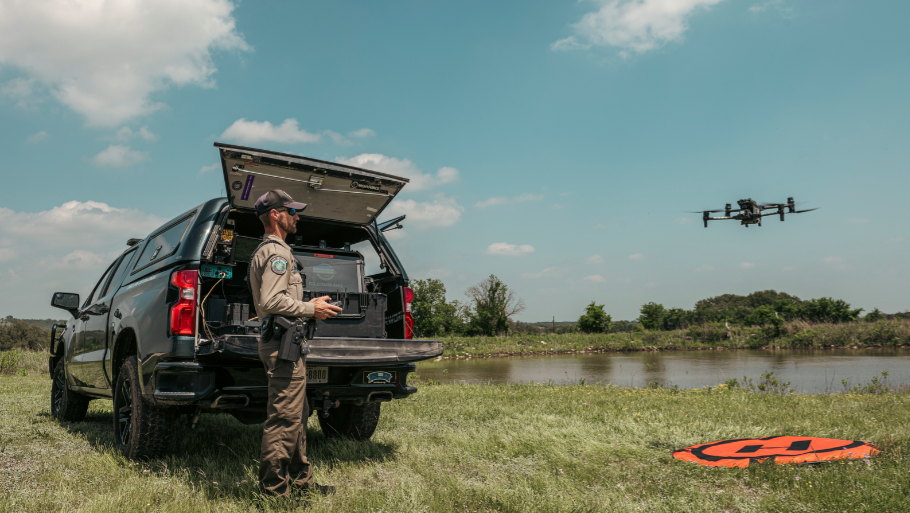
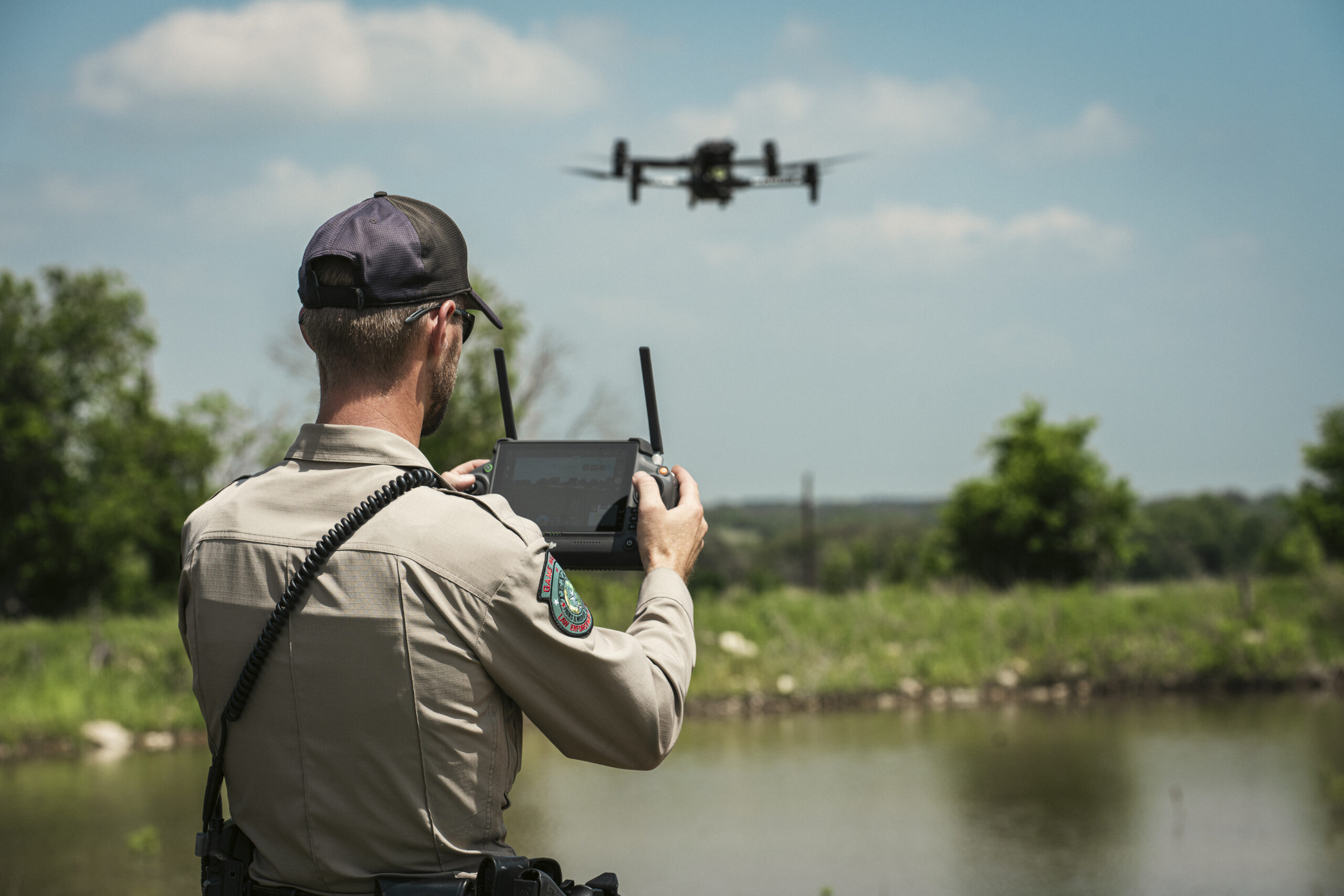
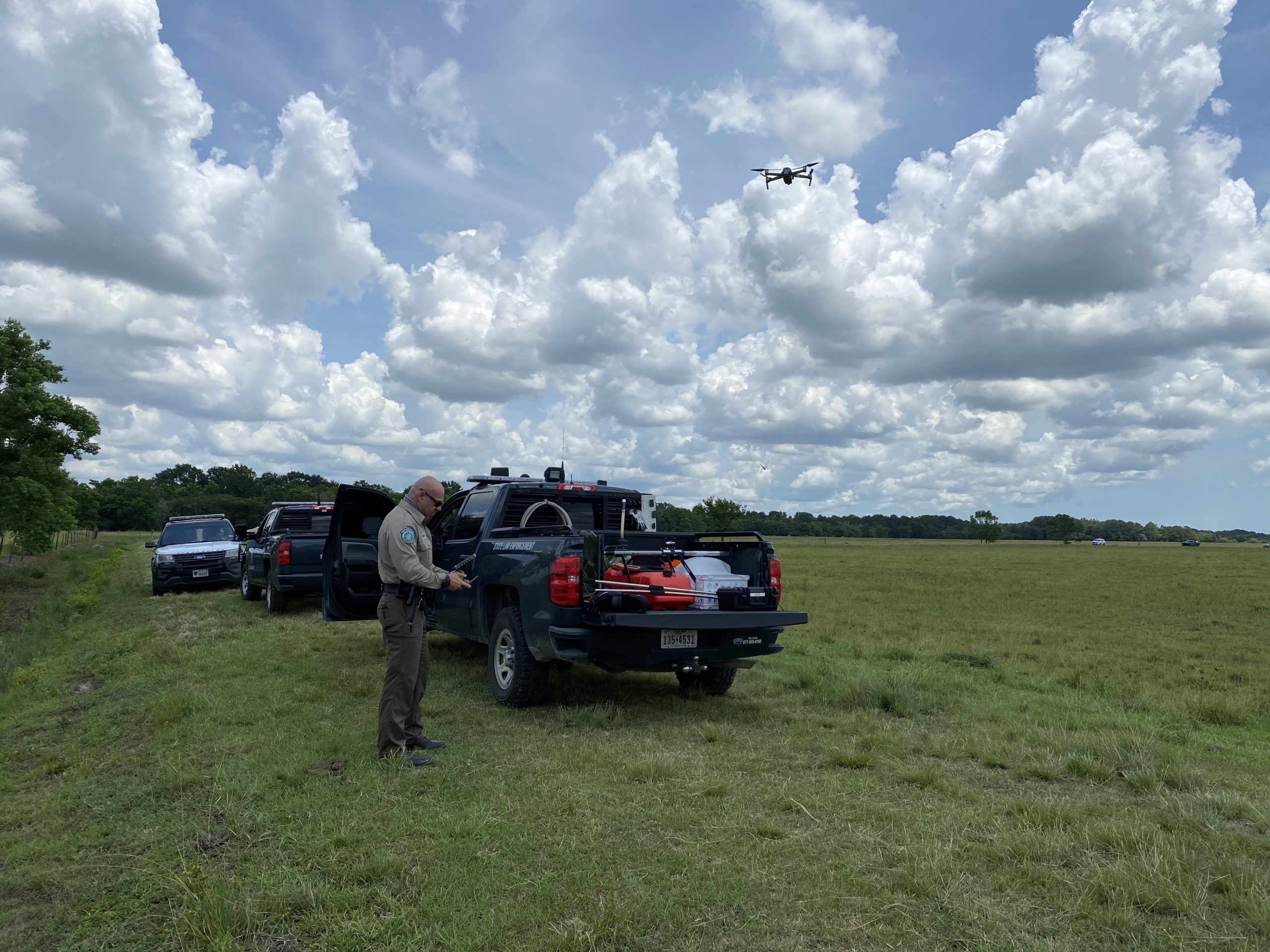
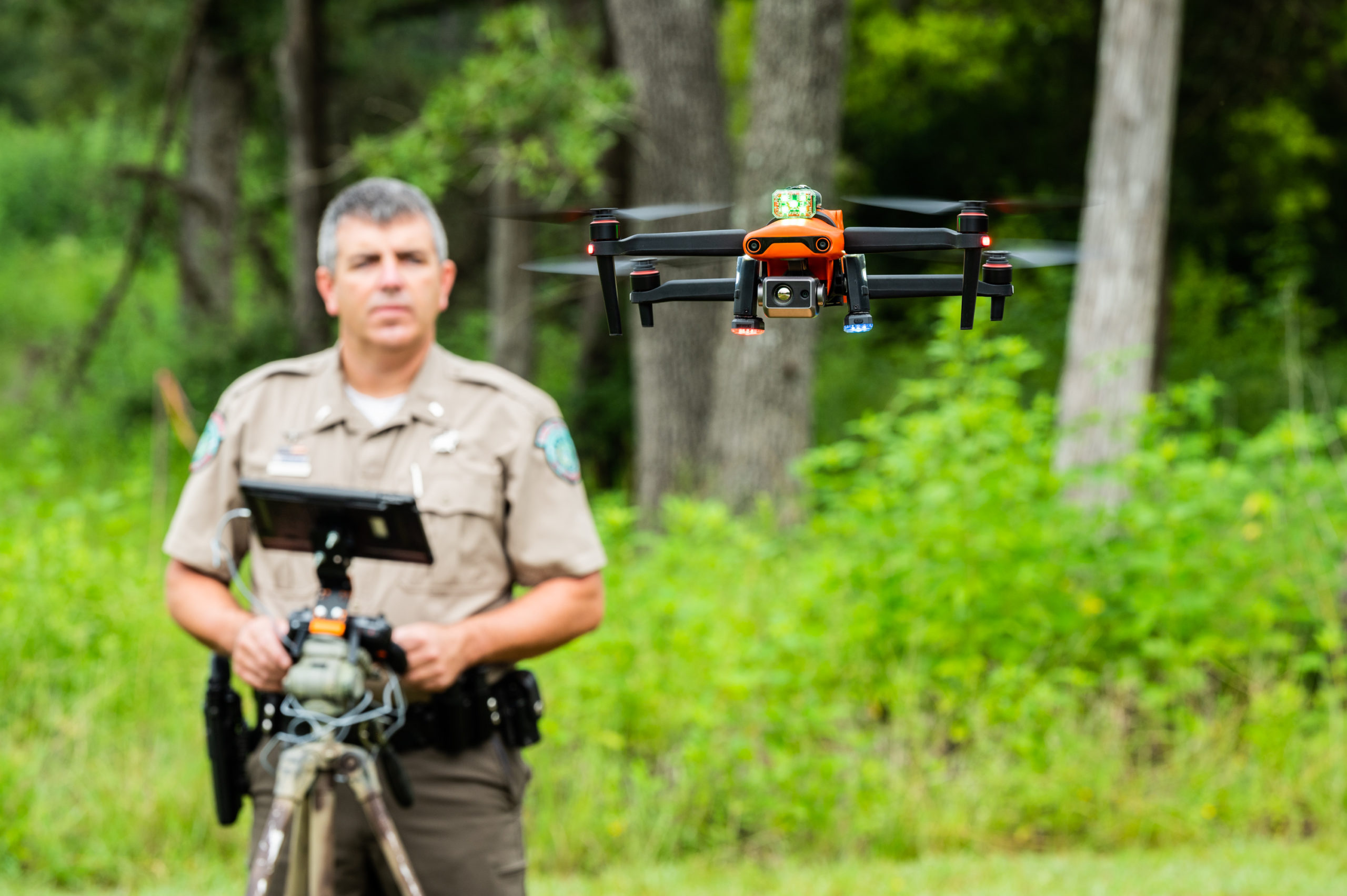
When floodwaters raged through Central Texas on July 4, 2025, Texas Game Wardens used Unmanned Aircraft Systems (UAS)—or drones—to save lives and bring critical clarity in the middle of chaos. What seemed extraordinary that day was the result of years of steady investment and training in a program that has transformed how Texas responds to disasters.

The Texas Parks and Wildlife Department’s Law Enforcement Division first tested drones in 2018. At the time, it was a small trial run, with just a handful of game wardens trained to fly aircraft that were still considered experimental in law enforcement. Lt. Matthew Bridgefarmer was there from the beginning.

“The program went live in 2018 as a test, really just a trial balloon,” Lt. Bridgefarmer recalled. “We started with about a dozen pilots and one drone. Within a year, it had grown to every region of the state, including park police. We went from that handful of pilots to around 60 statewide.”

The original focus was search and rescue. The goal was simple: to get eyes in the sky quickly and find people faster. Even in its infancy, the program showed how powerful that could be. Texas Game Wardens have used drones to locate missing people in hard-to-reach areas, scout swift water hazards before boat teams entered dangerous currents, and even deliver life jackets to people caught in the crosshairs of dangers currents.

Nearly 90 percent of the active fleet has been funded through Texas Parks and Wildlife Foundation’s S. Reed Morian Gear Up for Game Wardens program. What began as a handful of donated drones has grown into a sophisticated statewide capability that has changed how Texas Game Wardens do their work.

“Today we have a fleet of roughly 75 active drones and 50 trained pilots,” Lt. Bridgefarmer said. “They range from small drones that can fly inside a collapsed structure to large models that can carry payloads. That growth and the quality of our equipment would not have happened without Gear Up for Game Wardens. We wouldn’t be where we are as a program without it.”

Philanthropy has been central from the very beginning. “When we first started Gear Up, we knew it could make a difference, but I don’t think any of us imagined just how far it would go,” said Randy Fowler, an early supporter of the program and current TPWF trustee. “Seeing these drones save lives, seeing the gear in action when it matters most—that’s why we do this.”

“For the dollar, drones are probably one of the most impactful pieces of equipment in the Gear Up for Game Wardens program,” Fowler added. “It’s incredibly rewarding to know our support is helping game wardens do their job safer, faster, and better.”

The drone Fowler helped fund was quickly put to use, and his support inspired others to follow. In the years since, Gear Up donors have funded dozens more, along with batteries, cameras, handheld thermal imagers, and mobile command kits that allow drones to stream live video directly to incident command. That capacity has given Texas Game Wardens new tools to protect Texans during floods, fires, hurricanes, and myriad situations that pose a danger.

The July 4 floods were a striking example of how far the program has come. Drones were flown across multiple river systems to guide boat teams, scout debris fields, and provide real-time situational awareness to command posts. At times, more than 20 live video feeds were streaming into the state’s operations center. One drone dropped a life jacket to a woman clinging to her rooftop, the first aerial delivery of its kind in Texas. At Camp Mystic, a drone was used to help guide helicopters and coordinate the evacuation of hundreds of campers and staff.

Lt. Bridgefarmer said the program’s success is not just about technology, but about training and teamwork. “We focus on mastering the basics so we can integrate with other units—swift water rescue teams, K-9 units, aviation, even SWAT,” he explained. “We train alongside them so that when an event happens, the communication is seamless and the integration is natural. That’s why it worked as well as it did on July 4.”

The equipment itself continues to evolve. Lt. Bridgefarmer has his eye on vertical takeoff fixed-wing drones that could stay in the air longer, cover more ground, and map wide areas more quickly. Heavy-lift models that can carry larger payloads, like cases of water or medical supplies, are also on the horizon. Those advances could make a profound difference in both search and rescue and disaster relief.

Since 2017, Gear Up for Game Wardens has provided more than $7 million in gear, and the drone program stands as one of its most visible successes. What began as a single donated aircraft has become a statewide system that is saving lives and shaping the future of law enforcement response in Texas.

For Lt. Bridgefarmer, the program is as personal as it is professional. “You don’t realize the extent that this equipment saves lives until you see it in action,” he said. “Without Gear Up, we simply would not have been able to do the work we’ve done.”

The sight of a drone hovering over a flood, fire, or search scene has become a familiar one in Texas. Those eyes in the sky represent more than technology. They represent a partnership between dedicated game wardens and generous Texans who believe in equipping them to serve. And as future disasters unfold, this galvanizing partnership will continue to shape how Texas responds.

Texas Game Wardens Answer the Call

By | Uncategorized

When historic flash floods swept across Central Texas on July 4, 2025, first responders across the region sprang into action. Texas Game Wardens, local fire departments, sheriff’s offices, DPS, and rescue teams mobilized to confront a disaster of staggering scale. Rain fell in relentless sheets, rivers surged over their banks, and entire towns were cut off within hours. Over the coming days and weeks, we’d come to realize that at least 135 Texans had lost their lives—a profound, devastating loss that could have been much higher if it weren’t for the urgent, coordinated frontline efforts of emergency responders.

Texas Game Wardens played a critical role in the effort. As fully commissioned peace officers with statewide jurisdiction, they bring a rare blend of law enforcement authority and search and rescue expertise. Trained to operate in the harshest conditions and equipped with boats, helicopters, K-9 units, and specialized tactical teams, they are often the first on the front lines when Texas faces natural disasters.

During the disaster, more than 375 game wardens and 475 specialized assets were deployed across multiple river systems, from the Guadalupe to the San Gabriel. They conducted 34 water rescues, evacuated 434 individuals, and assisted countless others stranded by rising water. They also provided early logistical support to local agencies and DPS in what became one of the largest mobilizations in the division’s history.

“It was an all-hands effort,” said Capt. Logan Griffin. “From swift water boats to boots on the ground, we were fully engaged. But it wasn’t just us—it was a true team response across agencies.”

Behind those numbers are stories of courage, quick thinking, and extraordinary teamwork. One of the most dramatic missions unfolded at Camp Mystic, a summer camp near Hunt that was suddenly cut off by floodwaters. With no power, no cell service, and hundreds of children and staffers stranded, Texas Game Warden Dusty Jansky was airlifted into the camp by a TPWD helicopter along with a swift water rescue technician. Rain was still falling and debris choked every road.

His task was to provide critical communications and situational awareness while guiding efforts to evacuate campers. Working with camp staff and other responders, Jansky helped coordinate the air evacuation of more than 160 campers to reunification centers. Game wardens transported another 170 by vehicle once debris was cleared from the roads.

For Jansky, the day was a blur of tasks: running communications, relaying information to ground teams, and directing resources where they were needed most. He worked nearly 20 hours before collapsing into bed after midnight. “It’s a day I’ll never forget,” he said. “We can wash the mud off our trucks and out of our uniforms, but we’ll never get it out of our hearts or off our minds.”

The flood didn’t just test the training of Texas Game Wardens—it also tested their equipment. Much of what they relied on came through Texas Parks and Wildlife Foundation’s S. Reed Morian Gear Up for Game Wardens program. In the days immediately following the disaster, Gear Up worked quickly to replenish what had been lost or damaged. Hundreds of new Sitka boots, gloves, and safety glasses, and dozens of prop blades for swift water boats were rushed to the Kerrville Law Enforcement Office, while additional equipment was ordered to keep pace with ongoing operations.

“Gear Up allows us to evolve at a much higher speed,” Griffin said. “This program puts the right tools in the hands of game wardens when they need them most.”

Since its launch in 2017, Gear Up has provided more than $7 million in equipment for Texas Game Wardens. The July 4 floods proved just how vital that investment has become—not only for the game wardens who risk their lives, but for the Texans they protect.

As Col. Ron VanderRoest, head of TPWD’s Law Enforcement Division, told lawmakers after the flood, “The dedication of our Texas Game Wardens reflects our commitment to public safety, resilience, and service.”

Meet Texas Game Warden Sergeant Derek Nalls

By | Uncategorized

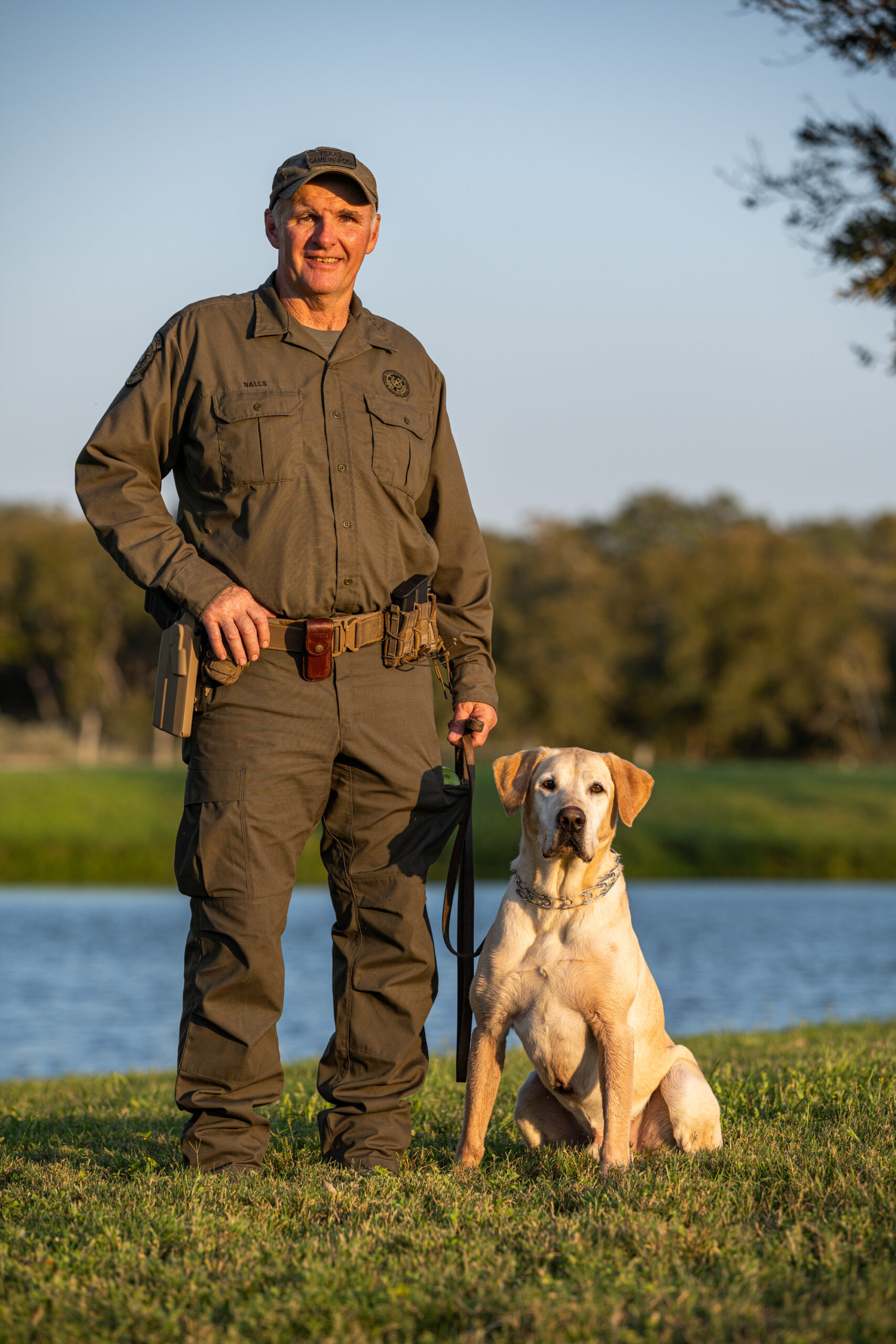
Sometimes it takes a second act to find your first calling. This was the case for Sergeant Derek Nalls, a Texas Game Warden and K-9 Handler who just recently retired after a rewarding 23-year career patrolling and protecting the lands, waters, wildlife, and people of Texas.

Ever since he can remember, Nalls wanted to be a Texas Game Warden, but life ultimately took him down a different path. “When I was 15, I spent my summers and weekends working for my uncle, a home builder. I became really good at it, but before you know it, 20 years had passed,” said Nalls. At 36 years old, he still couldn’t shake the dream of becoming a game warden, and with his wife’s unwavering support, he changed course. “I went back to college for my second degree, this time in criminal justice. I then applied for the Game Warden Academy. On my fourth attempt, I was accepted!”

At 40 years old, Nalls proudly earned his Texas Game Warden badge.  His early assignments took him across the state, from Harrison County to Shelby County, and eventually to far West Texas and the Panhandle before he made his final move to Nolan County. Here he embarked on a new mission—becoming a K-9 handler.

In 2013, Nalls was part of Texas Parks and Wildlife Department’s (TPWD) inaugural K-9 team. The first K-9 partner he trained was Woodrow, who was certified in narcotics detection, tracking, search and rescue, and article search. Together, Nalls and Woodrow answered hundreds of deployments, but his most memorable remains the very first time Woodrow located a missing person.

“I was called out to a school to help locate a ten-year-old student who ran away after getting in trouble. I turned Woodrow loose inside the building, and he hit upon a door that was cracked and began barking.” Thanks to Woodrow’s keen nose, the boy was found unharmed, hiding underneath a table. “He wasn’t so happy to be found because I think he knew he was in trouble, but it’s always a great feeling when you find someone alive and unharmed.”

In 2021, with Woodrow set to retire, Nalls began training his second K-9 partner, Skye, a high-energy black labrador retriever who was later certified in firearms detection, tracking, and search and rescue. Together, they completed over 80 deployments, from search and rescue to assisting in border patrol operations and other critical missions.

One of Nalls most memorable missions with Skye was when the pair was deployed to Callahan County to help locate and missing man who had health issues. “Night was setting in, and we needed to find him fast,” recalled Nalls. Skye was able to determine the general direction of the man, which helped Texas Game Warden and Drone Operator Michael Hummert to narrow his search using a thermal drone. Hummert found a heat signature on his second sweep, and Nalls and Skye were able to descend upon the man’s precise location. “He was thirsty and scared, but he was going to be okay, which is the outcome everyone wants in the end.”

As Nalls begins his retirement, he looks forward to spending time with his wife of 34 years, and he plans to take a few cues from his trusted K-9 Woodrow, who has become quite the pro at retirement. “I’m looking out the door, and he is laying in the sun as we speak,” joked Nalls. Skye, newly retired and still full of energy, will also remain by his side as a cherished companion.

“There’s a saying we use in the field—it’s called ‘dropping the lead.’ It’s time for me to drop the lead and let the youngsters take over. I have a boat that hasn’t been cranked in two years. I want to go fishing. I want to hook up the travel trailer. It’s bittersweet, but I think I’ll find plenty to do.”

Donor Profile: Margaret Martin

By | Uncategorized

Margaret Martin grew up on a South Texas ranch near Laredo, and that experience connected her to nature in a way that inspired her lifelong commitment to conservation. She served on many local agriculture-focused boards before Governor Rick Perry tapped her to serve on the Texas Parks and Wildlife Commission in 2007, where she served until 2015.

“That changed my life,” she said. “I thought I had a good idea of what Texas Parks and Wildlife Department (TPWD) did, but I really had no idea of the vast scope of the Department’s purview until I served on the Commission. The incredible variety of things that TPWD does is amazing. From the network of state parks and wildlife management areas to the wildlife and fisheries biologists who help conserve our precious natural resources, and the wonderful men and women who serve as Texas Game Wardens, TPWD touches so many things that Texans hold dear.”

Martin has been a lifelong supporter of Texas Game Wardens, and in 2012, Martin led the charge on the Commission to support a K-9 unit in TPWD’s Law Enforcement Division.

“I was all in and thought it was a great idea,” said Martin. “What a great partner for the men and women who serve the people of Texas. These K-9s have abilities that humans don’t, and I was pleased to support the establishment of the first-ever K-9 team for Texas Game Wardens.”

Martin not only supported the concept, she also made a personal donation to TPWF to help make it happen. As the official nonprofit partner of TPWD, TPWF was instrumental in raising the private funds that turned the concept of a Texas Game Warden K-9 team into a reality.

In 2016, Martin joined TPWF’s board of trustees, where she is happy to continue supporting Texas Game Wardens and TPWD.

“Being a Texas Parks and Wildlife Commissioner before coming onto the TPWF board has given me a unique perspective in understanding how important Texas Parks and Wildlife Foundation is to the Department,” she said. “It’s a great partnership.”

In the first few years of the K-9 program, TPWF funds helped purchase dogs and paid for the necessary equipment and training for the dogs and their handlers. In 2017, TPWF launched the S. Reed Morian Gear Up for Game Wardens program, where funds raised keep the K-9 team running. In 2020, Gear Up established a dedicated fund to replace K-9s when they retire, which provides a seamless transition for the K-9 team. Martin has been a steadfast supporter of the K-9 program every step of the way.

“These amazing K-9s play a critical role in search and rescue operations that have literally saved lives, and they lead the way in a variety of missions across the state. They can do anything their handlers ask of them, and they are a great asset to the people of Texas. Plus, they’ve stolen my heart! I hope other Texans will join me in supporting Texas Game Wardens and their K-9 partners.”

Meet Texas Game Warden Raj Ataya

By | Uncategorized

Raj Ataya began his career as a Texas Game Warden a little later than most.

“In my late thirties, I decided I wanted to be a game warden,” said Ataya. “I applied to become a Texas Game Warden cadet, got in on my first try and graduated from the Game Warden Training Center in 2017. My first duty station was in Orange County, which is very close to home. I’ve been here ever since.”

Ataya’s experience was a little unusual because the vast majority of those who are accepted to become a game warden cadet don’t get in on their first try. Most years, about 90% of Texas Game Warden cadets have tried at least once, and sometimes several times before being selected for the highly competitive training academy.

Ataya’s life experiences are also atypical for most game wardens. He graduated from Baylor with a degree in international business and entrepreneurship and built a successful business involving restaurants and real estate right out of college. He is still a partner in the business, but no longer involved in the day-to-day work that keeps it running.

“When I was young, I wanted to be in law enforcement, but I put that dream aside after college. After I got my business established, I started thinking about law enforcement again and right about that time, I met Texas Game Warden Colt Crawford at the gym. He became my workout buddy, then best friend, and he took me on several ride-alongs to show me what he did. That sealed the deal and I decided to go for it.”

Ataya’s dedication to his new career is evidenced in everything he does, including returning to school to earn a master’s degree in criminal justice from Lamar University, a feat he accomplished while working fulltime as a Texas Game Warden. He loves just about everything about his job, especially his duties related to water safety.

“I really like being on the water, and I enjoy operating all the different types of vessels that we have. Airboats, patrol boats, surface drive boats, flat-bottom boats and SAFE boats; we have it all over here. I also really enjoy being connected to the local community here. That’s a big priority for Texas Game Wardens.”

Ataya’s work has been recognized at the local, state and even national levels. In May he was honored by the Texas Parks and Wildlife Commission as the 2021 National Association of State Boating Law Administration (NASBLA) Texas Boating Law Enforcement Officer of the Year. This award recognizes an officer who has made outstanding contributions to the field of boating law enforcement. He won NASBLA’s Southern Region Officer of the year in July and is one of three finalists for the top national award, which will be announced soon.

Ataya is plugged into his community and is very appreciative of the support Texas Game Wardens receive from local citizens and businesses through Texas Parks and Wildlife Foundation’s Gear Up for Game Wardens program. Gear Up for Game Wardens raises private funds for specialty gear that helps Texas Game Wardens do their jobs more effectively. A recent fundraiser in Beaumont raised more than $100,000 that was put to use immediately. Gear Up funds were used to purchase a Minn Kota Raptor, which allows Ataya to drop an anchor when he ties on to another boat for a law enforcement check.

“I’ve used it more than 50 times in the last couple of months. It anchors both boats in place so we don’t have to worry about drifting while we are making a check. It’s a wonderful piece of equipment that helps us do our jobs safely.”

While Ataya spends a lot of time on the water, his other specialty is as a drone operator. He is called in often to assist in search and rescue and other law enforcement operations.

“Gear Up has been a godsend because there’s no way we can keep up with the fast-changing technology. Thanks to these private donations through Gear Up, we have access to the latest thermal drone technology.”

As Ataya continues to do the job he loves, he is heartened by the support Texas Game Wardens receive from his community through Gear Up for Game Wardens.

“It’s really amazing and it gives us a real good feeling to know that support is there. We’ve got a very special relationship with these folks, and we’re proud to serve them as Texas Game Wardens.”

Gear Up for Game Wardens Provides the Latest Drone Technology for Texas Game Wardens

By | Uncategorized

Texas Game Wardens strive to use the latest and best gear and technology in their mission to serve the people of Texas. But outfitting more than 500 Texas Game Wardens with more than standard-issue equipment is a daunting task. That’s why Texas Parks and Wildlife Foundation (TPWF) created Gear Up for Game Wardens in 2017. Through private donations, Gear Up for Game Wardens provides specialty gear to Texas Game Wardens across the state.

Through the generosity of donors, Gear Up for Game Wardens has provided gear and equipment including all-terrain vehicles, airboats, and funding to replace retiring K-9s. Helping Texas Game Wardens keep up with the latest drone technology is another way Gear Up for Game Wardens is helping to protect the people of Texas.

“We have only had access to drones to assist us in our law enforcement work since 2018,” said Lt. Game Warden Matthew Bridgefarmer, who coordinates the Unmanned Aircraft System (UAS) program for Texas Parks and Wildlife Department. “We started using them for search and rescue missions, and quickly realized how useful they are in those and other law enforcement situations.”

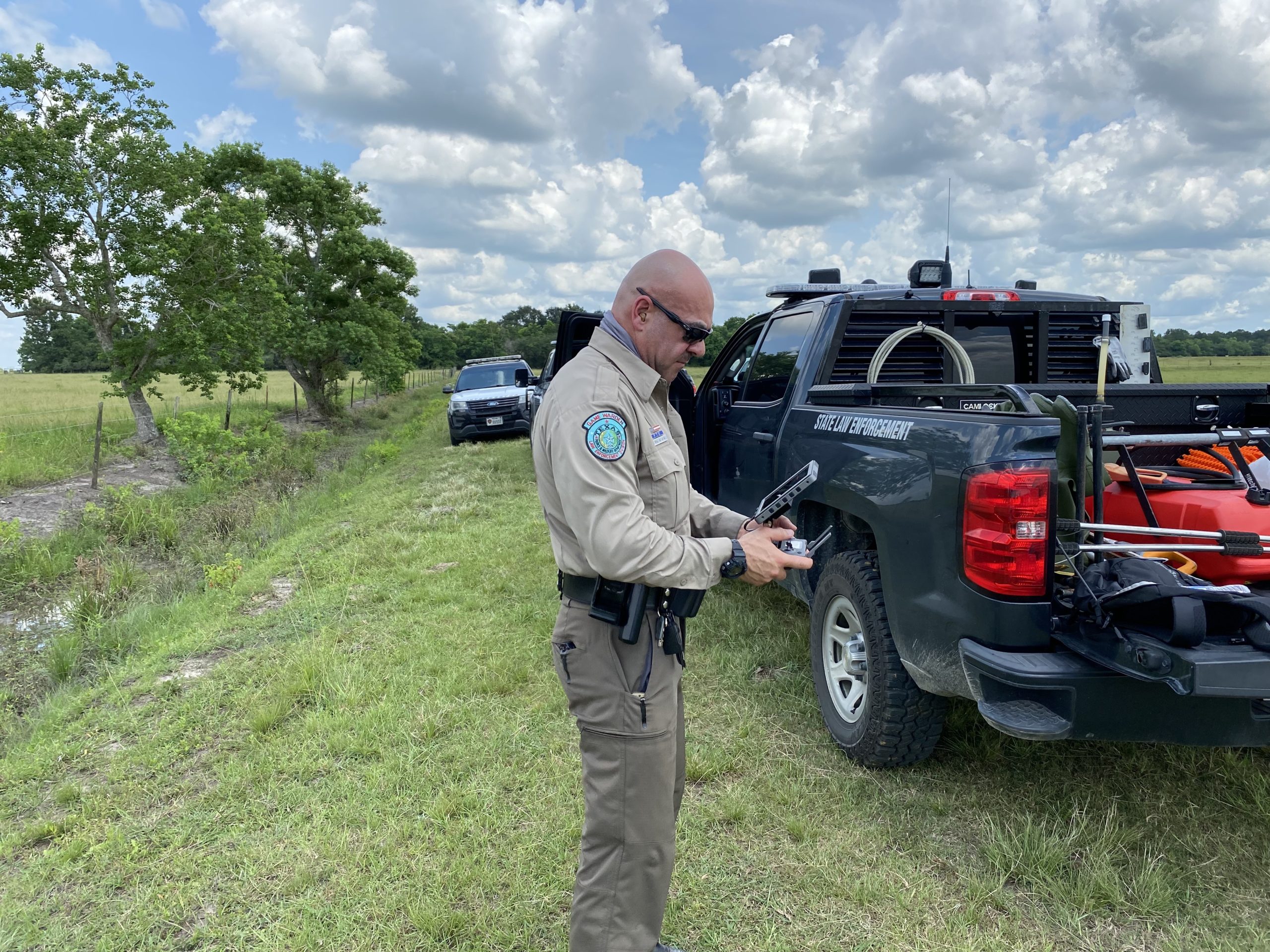
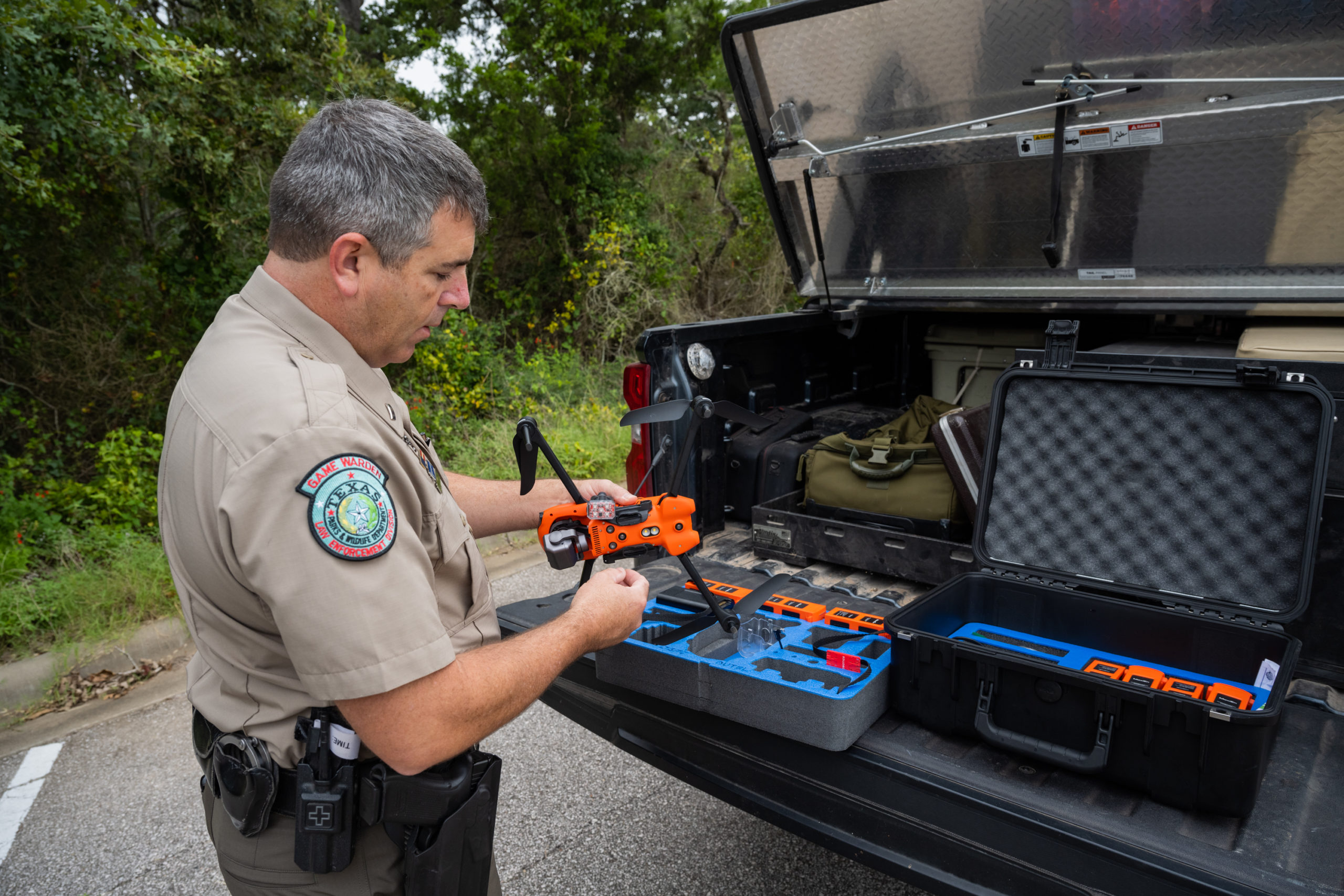
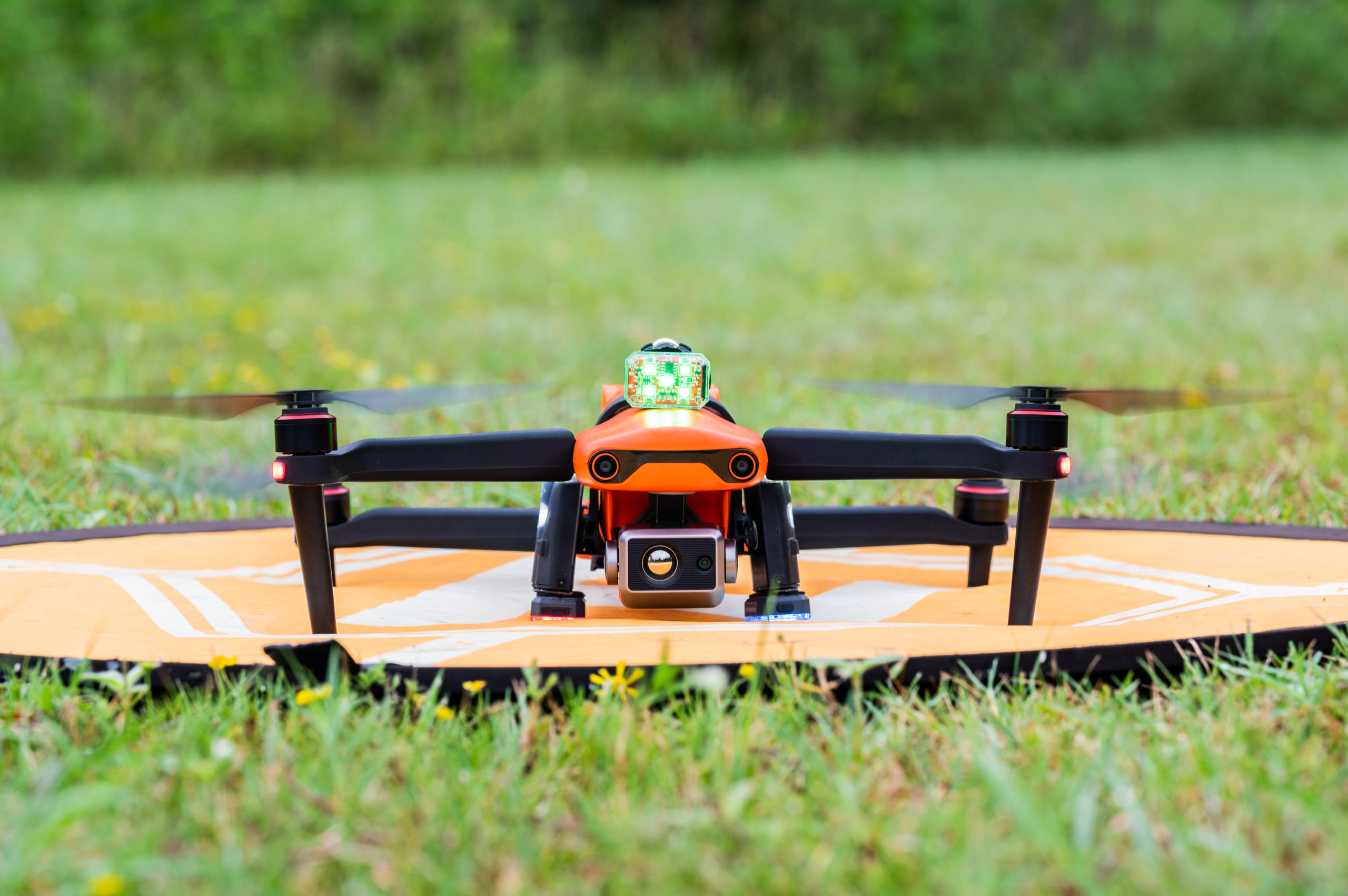
Drone technology is changing rapidly and providing the latest models to Texas Game Wardens is a priority for Gear Up for Game Wardens. One of the latest models is the new Autel Evo 2, which is a thermal drone that is smaller than previous models, can detect heat signals for night missions, and has a longer battery life.

“This latest model is a small compact foldable drone that will fit in a backpack if a game warden needs to hike in for a mission,” said Bridgefarmer. “The thermal camera has eight times the magnification, and the battery allows for another 15 minutes of flying time. That extra time can make the difference between a successful and unsuccessful mission.”

In addition, the new model is about half the cost of previous versions, which means dollars raised through Gear Up for Game Wardens can provide additional drones for more areas of Texas.

“The UAS program has grown quickly over the last few years, and we have 68 drones deployed around the state,” he said. “The majority of them were provided through Gear Up. If it wasn’t for the generosity of these private donors, our UAS program would be a fraction of what it is today.”

Texas Game Wardens are also Texas Peace Officers and are often called upon as force multipliers for smaller law enforcement agencies, especially in rural areas. Over the last 12 months, Texas Game Warden drone operators have participated in 70 search and rescue operations, 49 felony manhunts, 33 border security operations, 16 criminal investigations, and seven drowning recoveries. They are also used to assess disasters, investigate boat accidents, fight fires, and provide training support.

There’s a story behind every single one of those statistics. For example, earlier this year on February 27, Texas Game Wardens were called in to assist in the search for a man who was lost at Lake Meredith National Recreation Area in Potter County. The elderly man, who had diabetes and suffered from cognitive issues, was able to call 9-1-1, but he had no idea where he was. Night had fallen, and temperatures were in the 50s. The local game warden had trained with the new Autel Evo 2 drone just 17 days before and helped local sheriff’s deputies make a safe rescue to reunite the man with his family.

Texas Game Wardens who raise their hands to become drone operators do not receive additional pay for their extra duty. They take it on because they want to be able to deploy the latest technology to get their job done for the people of Texas.

“The fact that this equipment is being provided through private donations is just phenomenal,” said Bridgefarmer. “It’s extremely humbling to realize that, especially in this day and time, there’s still folks that support our core mission of conservation law enforcement and protecting the people of the state of Texas so much that they’re willing to open up their wallets. We all appreciate it and it helps stoke that internal fire that keeps us going.”

Eagle Scout Supports Texas Game Warden K-9 Team

By | Uncategorized

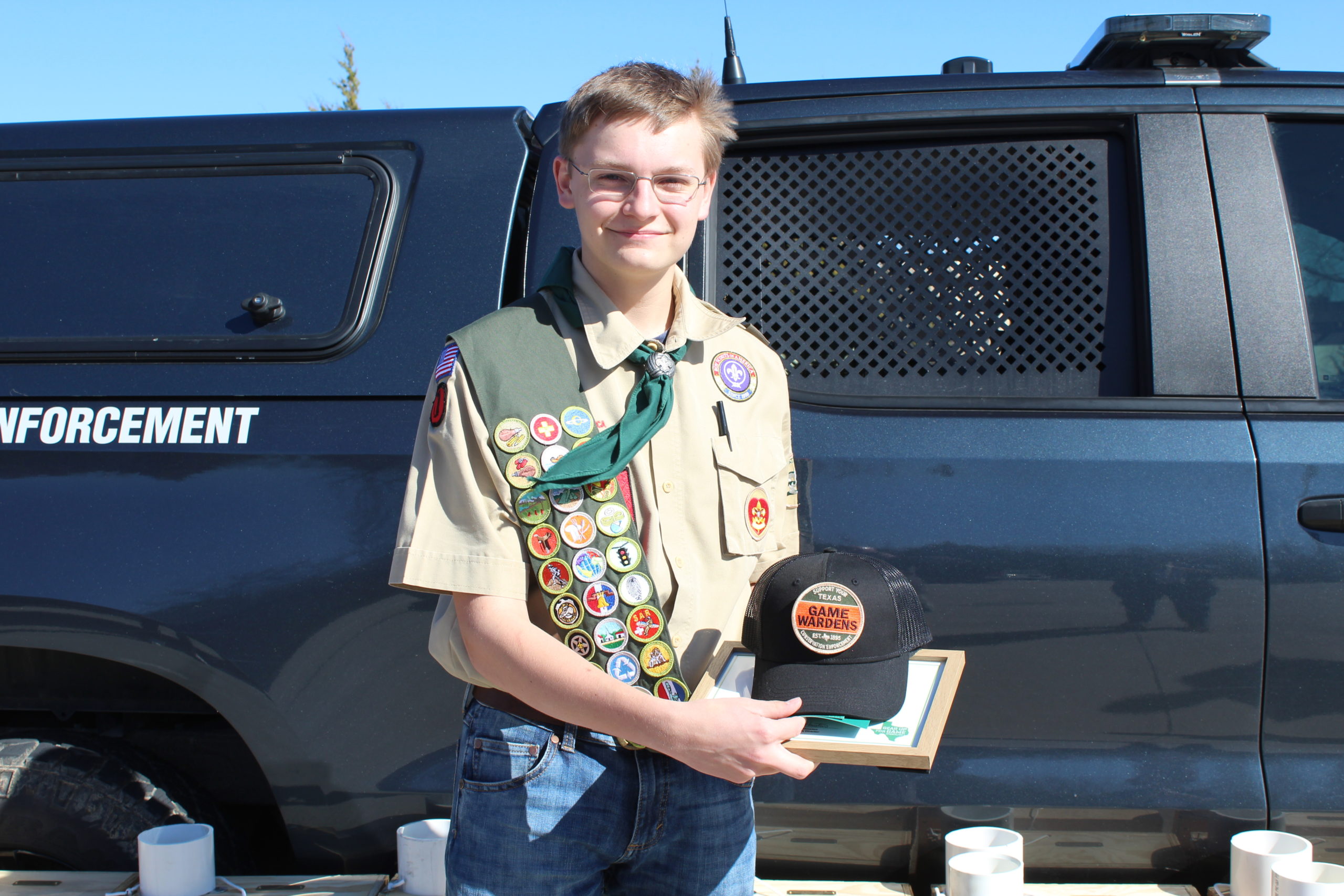
Shane Menz has spent more than two-thirds of his young life as a Boy Scout. His parents have supported him every step of the way. Now they are beaming with pride as he attains the coveted rank of Eagle Scout. It’s been a 12-year journey for Menz that culminated with 21 merit badges and a service project that will benefit the Texas Game Warden K-9 Team.

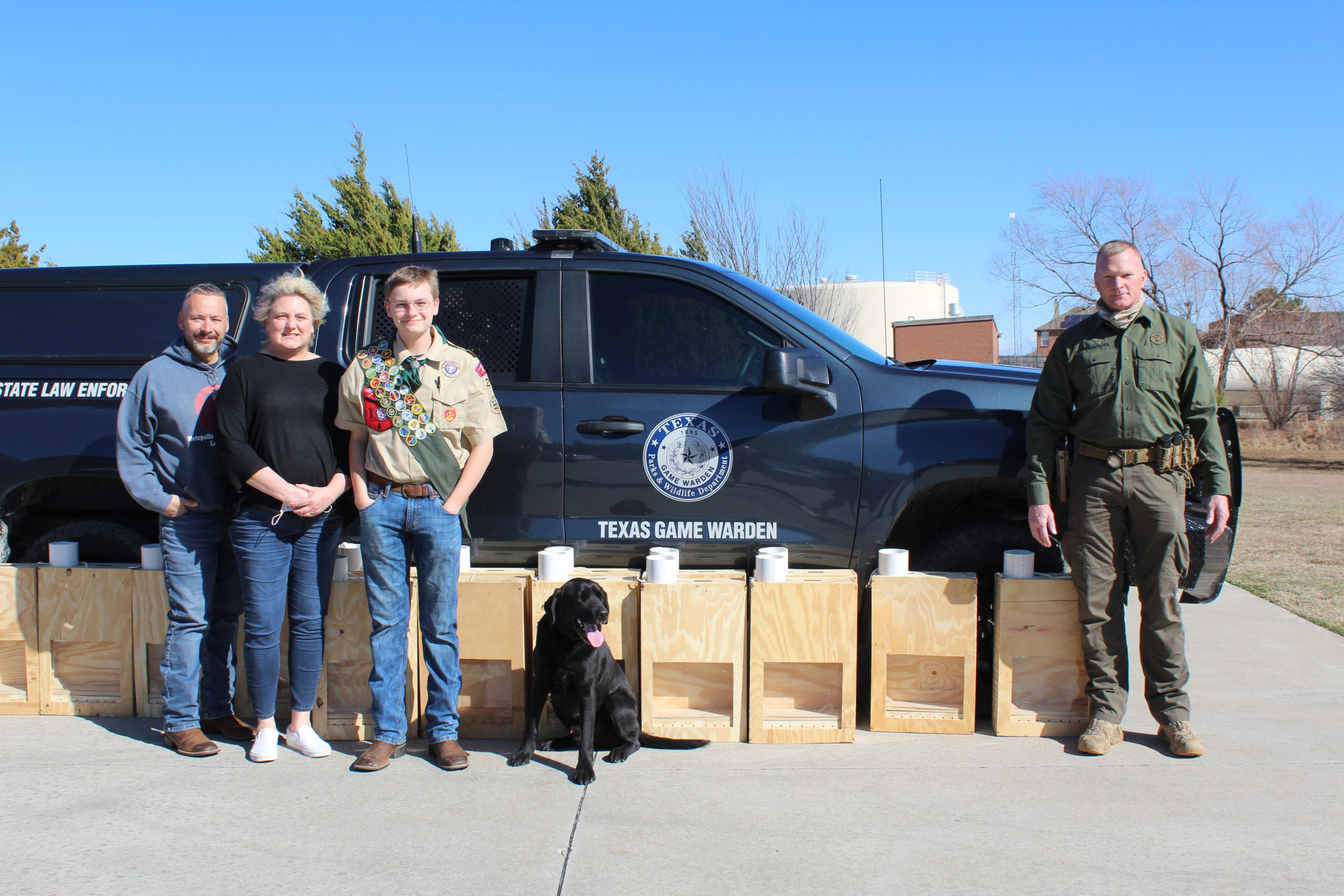
“I’ve always had an interest in training dogs because my dad is a police officer and works with K-9s,” said Menz. “I have grown up around police working dogs my entire life. About the time I was thinking about what I would do for my service project I met Texas Game Warden Scott Kirkpatrick and his K-9 Partner, Ray.”

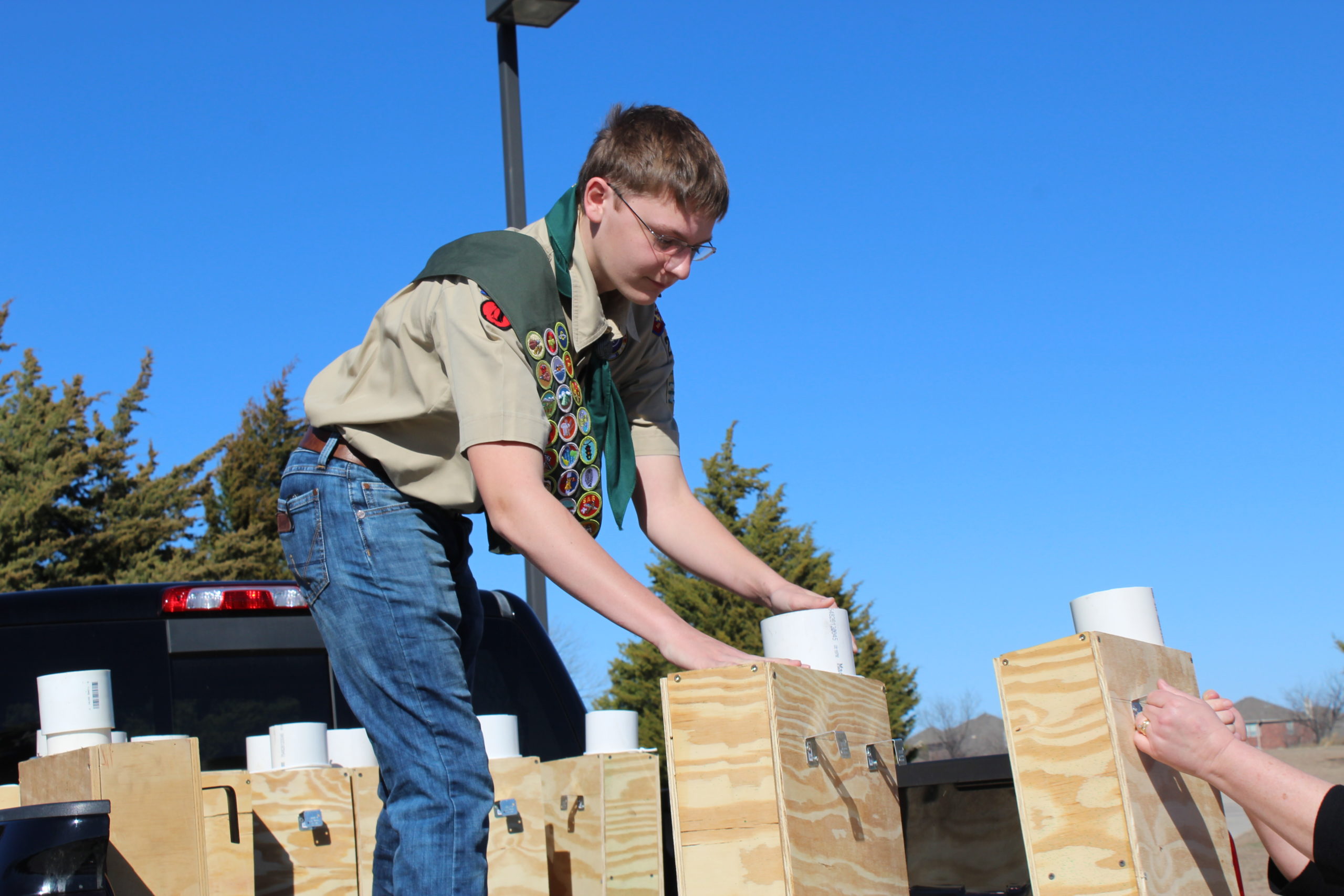
Menz is fascinated by how the K-9s are trained to detect different odors, from rescuing people in search and rescue missions to sniffing out narcotics. Kirkpatrick explained how scent boxes are used in training the dogs for game warden work, and that there weren’t enough of the boxes available for all of the Texas Game Warden K-9s stationed around the state. Menz decided that would be the perfect Eagle Scout service project.

“I saw that scent boxes could assist them in training their K-9 partners in the detection disciplines,” said Menz. “I was very impressed with how the boxes were used and decided that this project would have the most impact now and in the future for training detection dogs.”

The project required purchasing building materials, including plywood and PVC pipe. Prospective Eagle Scouts are required to raise the funds necessary for their projects, but COVID 19 shut down traditional fundraising events. Menz’s parents helped him set up a GoFundMe effort online.

As it turned out, Home Depot ended up donating most of the supplies, so they ended up with a fundraising surplus of close to $700.  Menz decided to donate those funds to Gear Up for Game Wardens, the Texas Parks and Wildlife Foundation (TPWF) program that raises funds for specialty equipment for Texas Game Wardens.

“We were thrilled to hear about this donation, and we’re earmarking the funds to benefit the K-9 Assistance Fund,” said Austin Taylor, who manages the Gear Up for Game Wardens program for TPWF. “The K-9 Assistance Fund provides the resources to replace retiring K-9s on a schedule that will allow for continuity within the K-9 Unit.”

Menz and his parents met Kirkpatrick recently to hand off the 15 scent boxes, which will be distributed to K-9 Teams across Texas.

“We’re all proud of Shane for the work he put into this project,” said Kirkpatrick. “I did a little research about Eagle Scouts and learned that only four percent of those who enter scouting achieve the rank of Eagle Scout. It’s a big deal, and somebody who has that kind of drive is going to succeed in life.”

Shane Menz already has his sights set on his next goal. He plans on earning a degree in Rangeland Ecology and Management from Texas A&M so that he can become a Texas Game Warden.

“That’s what I want to do with my life,” said Menz. “Maybe one day I will be able to use these scent boxes to help train my own K-9 partner as a Texas Game Warden.”

The fundraising goal for the K-9 Assistance Fund is $74,000 and with Shane’s recent donation and others, the total amount raised so far totals $73,219.

Make a Gear Up for Game Wardens donation today, and help push us over the top!